Showing posts with label Siebenthaler Fen. Show all posts

Tuesday, August 9, 2011

The Birding Curve

Prothonotary Warbler in Wet Woods

I recall a brief greeting several years ago in an exchange one spring afternoon beside a boardwalk.
“The prothonotary has returned!” he said.
But as I stepped onto the wooden-planked path looping the lake at our local nature center, the excitement this announcer had hoped to read on my face as he joyfully told me of his discovery was clearly absent.
I didn’t know this bird and, although I might have been able to conjure up a vague image in my mind from browsing the plates of warblers in my field guide, the proclamation of its presence there meant little…to me.

Years later, I would learn this bird while walking one summer afternoon on another wetland boardwalk, deeply shaded and winding between tall swamp cottonwood trees that stood in several inches of water.

Ebony Jewelwing damselfly, male

A ringing call had stolen my attention from the black-winged damselflies that were knitting up the frayed edges of a patch of sunlight--a brief, bright spot in the darkened, wet woods. The song's source had eluded me, though, for quite some time, as I stood peering past the thick, leafy cover where a small bird restlessly flitted, low to the ground, foraging close to the water’s edge.
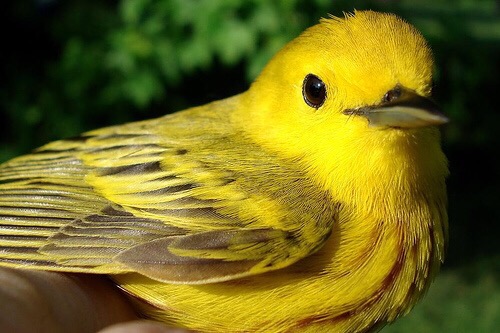
Eventually, I matched both sound and sight to the boldly yellow-colored warbler in my field guide--the Prothonotary.
An afternoon’s shelter from the strong light and heat of July and my pursuit of ebony jewelwings had given me a life bird, time to stand and watch it work this wetland habitat, time to soak in the rich sound as it spread across the water, golden as the bird from which it flowed.

For the remainder of that summer, I found prothonotary warblers everywhere.
From beside every lake that I canoed,
every quiet river that I kayaked,
every river-rimmed trail that I hiked, I found the song and it followed me--and often, gave a glimpse of the golden bird--until I knew it well and understood the joy of finding its return.

Meadow of Siebenthaler Fen

This summer I walked again on the wetland boardwalk where I’d first found my prothonotary warbler, though this time it was butterflies that were on my mind—Baltimore Checkerspots.
In the sunny meadow, a handful of the uncommon flutterbys skipped, barely stopping to nectar
before whisking past and out of camera range.

Baltimore Checkerspot butterfly

Pleased that I’d timed my visit to find them flying, yet discouraged that in their flying, I saw so very little of them, I wandered slowly back along the boardwalk to the point where it passed into the darkened cottonwood swamp once again.

Cedar Waxwing

A small flock of cedar waxwings crossed the cattail marsh and landed just overhead, lining up shoulder-to-shoulder on the graceful branches of several small willows. Dragonflies paused in the sunshine of the wooden boards, then rose to course above its sedge-filled edges and tall reeds just out of reach of 2 green frogs sitting neck-deep and motionless in the cool water of the fen. Their watchful eye, for this moment, had turned to the northern water snake gliding silently behind them.
Yes, everything about this picture of a still, wooded wetland should suggest a prothonotary warbler. And, if the mangrove forests of coastal Central and South America had sustained him for the winter, the bird I found last year would be back to breed here once more.


Through the darkened woods, across the water that stretched between the cottonwood trees, came the resounding call—clear and bright as the little bird behind it. And, in knowing the bird, hearing his song as I’d heard it before in the very same spot along the trail, my heart made just a little extra beat.
No one felt it but me.
“The prothonotary had returned!”

Prothonotary Warbler, Protonaria citrea

The Prothonotary Warbler, Protonaria citrea, breeds in hardwood swamps and forested lakeshores of the southeastern United States and is named for the scribes (prothonotaries) in the Roman Catholic Church who wore golden, hooded robes. Dubbed the Golden Swamp Warbler by John James Audubon, it is the only eastern warbler to nest in tree cavities, often using the excavated holes of Downy Woodpeckers and building mossy nests in trees near or over standing water.

Adults forage in low foliage for aquatic insects, snails, flies, beetles and spiders.
Because the prothonotary warbler is extremely habitat specific, habitat loss (wooded wetlands in the southeastern US and mangrove swamps of Latin America) may cause this species to decline.


No matter where you might be on the birding curve—whether you’ve learned the prothonotary’s ringing call or have never even heard of such a bird, whether you’ve mastered all the species’ migration routes or are still fumbling to find the focus wheel of your binoculars—the Midwest Birding Symposium has something in it for YOU!
There’s no better way to improve your skills, than to put yourself smack in the middle of a bunch of better birders—experts who are passionate about sharing something they love with another and super-nice folks who fondly remember exactly where they were when someone showed them their first life birds.
It’s not too late to get registered.
You’ll be surprised how much fun birds and birders can be!
I’d love to see you there!

Official 2011 Midwest Birding Symposium Blogger

Stumble Upon Toolbar

Wednesday, March 25, 2009

To the Fen, again! (SWF)

Where do I go when I miss that squish?
To the Fen!
Again!

Common Cattail, Typha latifolia

Where, even in this dry spring, coolness seeps through the slats of a plastic boardwalk trail, winding its way across this wetland, fed from below by a shallow aquifer.

Beyond its boundaries, what must be vernal pools—for I hear wood frogs calling strongly in the distance, even in the daylight of this warm afternoon.
These woods of the fen, though, are mostly quiet, and I walk past the large pools of dark water, so still and reflective, hugging the tall, wide trunks of the Cottonwood trees.


Until, at the edge, I step out into a stand of Cattails, and the sleepy, slow pace of the woods is left behind. From all around, wild excitement, as Red-winged Blackbirds noisily call in the sunshine. And masses of slender, brightly colored stems, explode with flowers both dainty and bold.

Their feet in cool, clean water--Pussy willows.
The exuberance of one who will never know thirst.


all photos enlarge with a click


See more Skywatch here.

Stumble Upon Toolbar

Monday, December 29, 2008

Beyond Xenia


North, beyond the flat fields, where the stubble of corn stalks left standing fades to blond beneath a bright winter sun, and silver-roofed silos stand as sentries beside small, clean brick houses of the dozing mid-western farms, the historic town of Xenia welcomes rural travelers. Its stately, old city buildings, the picture of the picture-perfect town.
And beyond Xenia, on a bright and breezy day, we revisited the Fen.


Boardwalk trail of Seibenthaler Fen


From the edge of the nearly mile-long boardwalk, cottonwoods and sycamores stand in swamps that line the banks of the parallel waters of Big Beaver Creek. But, soon the planks turn and set out across the sedge meadows, small puddles of the cool, clear water from the aquifer below, seeping through to the spaces beneath our feet.

The marshes are a tangle of browns now. The dense summer greens, gone.
Cattails stand in great groups, their fine, downy droppings gathering in piles along the trail, keeping just ahead of the brisk breeze carrying us along. Dock, its sturdy, lined stem of deep rusty tones is backlit by the afternoon sun.
The fruits of Swamp rose and stems of Dogwood, shine as bright reds.
And the Willows, in deep, golden yellows.

View across Sedge Meadow


Rose Hips

Cattails

Dock stem and seeds
Rumex sp.


Golden stems of Willow beside the marsh

Scattered among the brown,
the colors of winter.
Such a fine greeting to visitors here.


Big Beaver Creek
December 2008

Big Beaver Creek
May 2008


Delicate seeded stems
beside marsh trail


View more ABC Wednesdays here!

Stumble Upon Toolbar

Sunday, May 18, 2008

A chat with Julie Z.


I enter a swamp as a sacred place.

~Henry David Thoreau


It never ceases to amaze me--the diversity of natural areas around us.
And, that as often as we go out exploring, there continue to be places brand new.

Siebenthaler Fen is part of the Beaver Creek Wetland complex, several miles east of Dayton, and less than an hour's drive from our home. A protected peat-forming wetland, it's fed by groundwater and offers a mile-long stretch of board walk, observation areas and a tower platform, from which to view these rare communities of plants and animals--without getting your feet wet.
And, for the 20th anniversary of the organization that oversees this unique area, an early morning walk led by Julie Zickefoose.

Big Beaver Creek, rimmed by willows and shrubby cinquefoil, reflected a bright blue sky in its quiet surface. While in the wet woods, the shaded water beneath the cottonwoods hides frogs and turtles.
Even on this cool morning, emerging.
Green frogs in green duckweed.
And the tiniest painted turtle that slips beneath the surface before excited fingers find their focus.


From the treetops, Orioles and Indigo Buntings shone brightly in the sunshine. Orange and blue. Defending territories in persistent calls.
The low, dense shrubby areas covering the birds and their nests well-- their songs the only clue to their presence.

Julie's ear caught the song of a Yellow-breasted Chat, and we watched--as she called him into view, mimicking his whistle and chatter. Flitting from branch to branch, before finally resting at the top of a small tree to sing in the open--his throat full with sound and pouring forth joy. In the thick green tangles, the bold yellow spot with black gape--he held us there, watching.

In the sedge meadows, Skunk Cabbage and Great Angelica showed their large leaves from between the narrow sedges.
What looked like grass, was not that at all.
There is roughness here--spines and burs.
Texture.


Even into the woods, rushes in dark, clear water.
Just tall enough to hide beneath--if you're young.
And don't mind muddy feet.


So much packed into this rich area.
And so much richer with a leader like Julie.

Boardwalk down from Tower


Skunk Cabbage Rolls


Julie & me, after walk

Stumble Upon Toolbar