Paired for Life
From behind us, a rosy sun emerged above the stand of pines, glowing warmly on our backs and upon the breasts of the gathering birds, casting their gray feathers countless shades from icy white to slate blue, and lavender to silver. Growing steadily in size as more arrived from their overnight roosts in the marsh, the massing in the field stood around a shallow puddle, facing the warming rays, their red foreheads ablaze. Across the brightening sky, the stars stepped back and hundreds of tiny, dark specks became the long chains of the noisy birds, drawn to gather here each morning, and whose distant rattling calls began to fill the quiet of a cold, November dawn.


 Ritual of the Dance
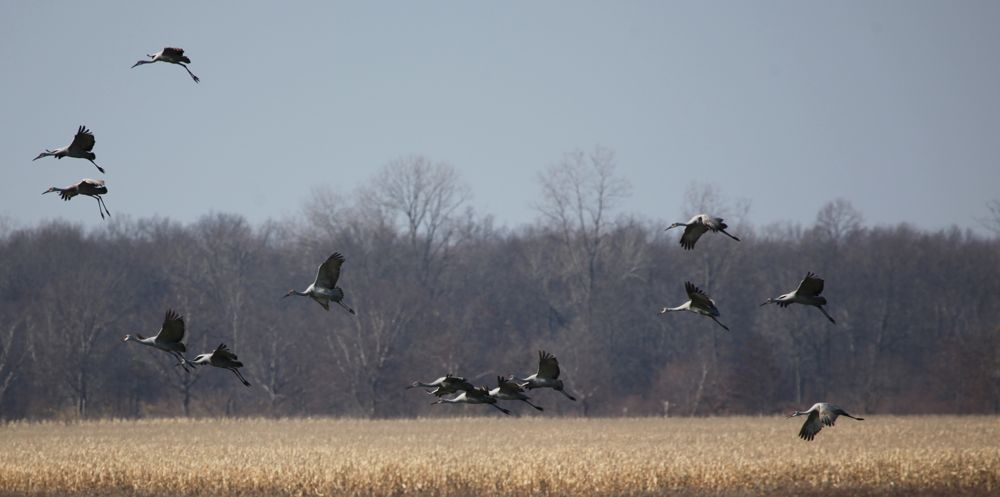
Those already on the ground danced and displayed, calling to their partners, standing with their young. While hundreds more dropped from the sky, joining the assembly from every direction. Out of perfectly synchronized spirals above the field, large groups turning as one, banking their 6-8 foot wingspans, landed--small parachutists floating gracefully to the grass. Then, they too, danced with their mate, this partner paired for life and tireless traveling companion. Barely heard between their constant calls, as the thousands of cranes filled Goose Pasture, was the airy whistle of the juvenile birds, this flight, their first of many.
 The Arrival of One Hundred

 Goose Pasture,
Jasper-Pulaski Fish and Wildlife Area
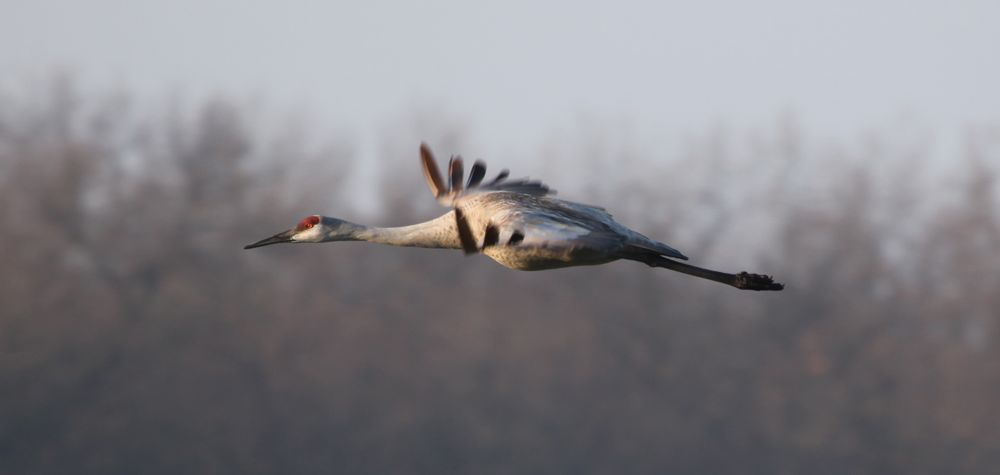
For several hours, birds continued to arrive--in pairs, small family groups and even great strings. Then forming large flocks facing the sun and with a few effortless steps, they took noisily to the air, flying low and calling out above the tower. We watched them leave for the surrounding fields, their necks stretched forward and black legs trailing, red foreheads brilliant in mid-morning sun, dancers' toes pointed, nails curled. They did not seem to mind the flurry of camera shutters, as all locked onto their steady orange eyes, and wide wings took them from view.

 Greater Sandhill Crane, Grus canadensis, in flight
 Flying off to the fields to feed
Later that day, we drove the nearby roads and easily spotted groups of them, standing in contrast to the dark, fertile soil, gleaning spilled corn from the expansive harvested fields, miles beyond Goose Pasture. Great flocks soared overhead reaching extreme heights, riding thermals, wing-to-wing as afternoon skies turned to blue.
 To Soar


Those that remained in the pasture for the day lined the grassy edge of the narrow drainage ditch--stepping in for a great, splashy bath; stepping out and preening in the warm, mid-day sun. With their long, dark bills, they probed the tender ground, raked the tall grass snagging small tidbits--earthworms, insects, and a small mouse-like mammal, which, with its discovery, became the object of much envy. Cranes beside the shallow puddle dozed in a one-legged stance, head tucked behind a wing. An occasional flutter would erupt from the otherwise calm crowd, and the pairs of cranes danced once again, bowing and raising their bills.


 Caring for those lovely feathers

 "Whatcha find, a shrew?"
 Adult and juvenile cranes
 Two pairs dancing

Looking out across Goose Pasture and the thousands of cranes gathered there that afternoon, each one just a part of this great migration, I could not help but think back to
my first crane sighting, just months before, while we traveled through northern Michigan.
How we struggled to find just the few, and reveled in catching a distant glimpse as they hurried out of sight, and hid themselves deep within the refuge.
How their hollow, rattled call in that vast, empty wilderness carried an almost melancholy air.
More than merely time between two places, I have come to understand that it is this great gathering together in migration that defines the Sandhill Crane.
Please continue to follow this story here. 

 Sunrise
 Sandhill Cranes in predawn sky
 Goose Pasture
 return of the cranes at sunrise


 Greater Sandhill Crane, Grus canadensis











%20copy.jpg)