Showing posts with label Spotted Salamander. Show all posts

Saturday, March 12, 2011

This is Spring

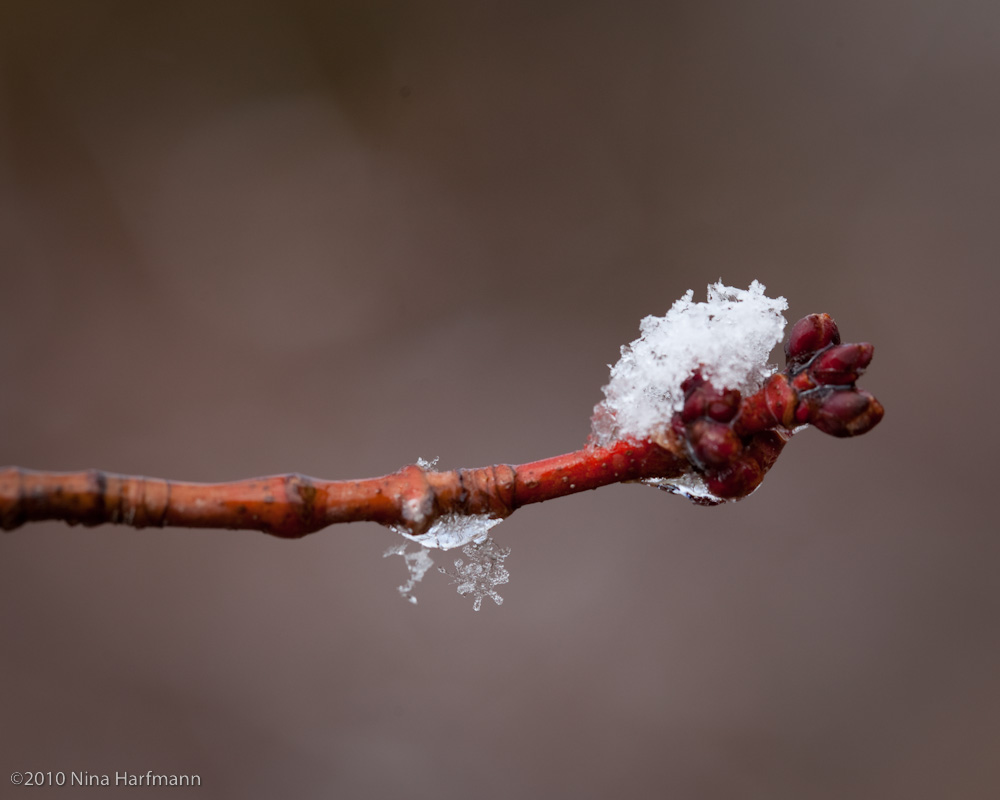
Snowflake on Red Maple

My ritual of spring has begun---with daily visits to each of my 2 vernal pools, now filled to the brim with melted snow and repeated spring rain, and nightly vigils as I wait for what I remember as clearly as if it happened just yesterday, the return of the spotted salamanders.

Vernal Pool

Lichen and Snow

But as I wait by the edge, spring steps forward and back, hesitating to make her bold entrance with a surge of warmth and bright sky. Instead, I find the ground beneath this small red maple crusted each morning with a thin but firm layer of ice. Its lichen-covered bark glows green on a clouded March morning.

Spring Snow and Spiders

Snowflakes spin on cords left by an ambitious spider who thought perhaps she’d wrap this small tree before its resident tree frog wakes and takes up its summer residence here. The water is dark and still. By noon most of winter’s remnants are gone. And the cold nights and crisp mornings of this week have filled the sap buckets that hang in the yard.

First Green

A few warm days have coaxed the first green from the earth. Tentative fingers emerge in the leaf-cluttered gardens ringing the old, brick house. Planted by a previous owner years ago, I know to expect them too. Their perfect green, soft and clean, has a tenderness barely hours old. They have brought a smile to my face--a smile that no one will see.

Another cold, clear night passes.
The day warms with sunshine until the mild air smells sweet. In the driveway, while curls of steam rise from the broad evaporating pan, gallons of maple sap steadily boil their way to become the prized amber syrup.
Beside the pool, the tangle of coarse weathered grass has become soft.
By evening, a warm rain begins to fall.

Crayfish foraging in leaves

In the dark, a brightly colored crayfish forages in the leaves caught in a crack beside the back porch floor. A steady run of rain from the roof spills onto his back as he moves slowly forward in this crevice, probing the puddles with his giant claws, sensing small bits of food with his antennae. The yard has come alive in this wet darkness.

With each step forward as I walk with my light, glistening earthworms brought to the surface to bask in the rainy night retreat hastily, disappearing to the safety of the softened ground.
And from beneath earth that lay frozen and buried beneath months of winter snow, from the woods they walk, crossing roadways, crossing lawns…stepping through my garden.

Spotted Salamander on Spring Migration

Where I first smiled a smile not seen, this time another is watching.


Spotted Salamander

The spotted salamander, Ambystoma maculatum, is one of the species of mole salamanders that lives underground for 50 weeks of the year, returning to vernal pools in the springtime for a brief 2-week period of breeding. These nocturnal and secretive amphibians are seldom seen unless encountered on their migrations to breeding pools at night.
Vernal pools seldom hold water beyond the summer months, appearing to be of little value in their empty state. Yet, to mole salamanders and wood frogs, these ephemeral wetlands are critically important.
More information about vernal pools can be found in previous posts.


Stumble Upon Toolbar

Tuesday, March 16, 2010

Sounds and silence


The sound of peepers fills the air.
With my eyes still closed in the dark of a cool, spring morning,
like sleigh bells through the field grass, their distant chime forecasts another warming day.


For weeks I’ve driven past the still snow-covered fields, each time, looking for a change—
a sign that this winter, longer than most and having left layer upon layer of snow, would lessen its hold. And along the trail, I’ve followed the footsteps of deer, whose tracks, preserved in snow, lie beside those of the coyote, though I know they pass here, each in their own time.

Horned Lark, Eremophila alpestris

Eastern Bluebird, Siala sialis

In the dark before dawn, I’ve heard the woodcock calling,
while, from the basin which I call Little Pond, wood frogs have begun to quack incessantly.
It is these sounds of spring, that speak for those most silent.
Who, drawn to the cool, clear waters of their birth,
with flashes of their long, spotted bodies, yet say, "spring."

Spotted Salamander, Ambystoma maculatum


Stumble Upon Toolbar

Monday, March 9, 2009

Hello!

It has been a very dry spring--one many would choose, eager for the warmth and beautiful rays of sunshine to follow this gray winter.
I, too, turn my face upward and draw it deeply in, yet it is not as it should be--
for this season is one of wetness.

I walk through the brown, dried, tangled grasses of the field, into the woods surrounding Wood Pool, shallower and already less wide than last year, my boots tossing the light, crisp leaves ahead of each step, scuffing along the dry trail.
And I wonder how they will walk here, tender bodies, without the softness left by rain.

Several males are already in Little Pond Pool, from journeys days ago, when light rain over warm earth released them to walk to this water. Each night I spent watching and waiting by the trail at midnight, hoping to meet them before losing them into the darkness of the pool. And, though I see their spotted bodies flash and turn below the water’s surface, it does not feel the same to find them already here.
I miss the walking.

Perhaps because this remarkable migration defines them.
Gathering these solitary beings for just several days into small pools of spring rain.
From adjacent fields and woods, acres beyond these borders, across roads and fences, they will return home.
Then, again, go off to disappear below the ground.

This evening dark clouds brought a beautiful rain.
And the grass glistened and shone brightly in the beam of my flashlight. I turned my face upward and drank in the damp night air.
And it was as I had hoped—
a salamander rain.


Spotted Salamander. Ambystoma maculatum, female
walking to Little Pond Pool
March 8, 2009

Another male (?)

Is there a sweeter, smiling face?


Spotted Salamander, female


View more ABC Wednesdays here!

See more Camera Critters here!

Stumble Upon Toolbar

Sunday, March 8, 2009

The Hidden Ones


I walk out to the pool each morning—the night’s frenzy so foreign, so shrouded.
Hoping to see better, in daylight, what lay hidden last night beyond the beam of my light. The quacking of Wood Frogs and piercing calls of Spring Peepers have gone with the night, though they are still here, replaced now by the raspy voices of Chorus Frogs, tucked away in the stems of plants peeking above the surface at the water’s edge.
With one step, they, too now are quiet.

Last night I stood in the same spot, within this ring of grass, a dense mat covering the bottom of the pool. Easing apart the tangled stems with my toe, careful not to tear into their world like ripping into a prize, I gently step in, and wait, still. Clusters of spermatophores shine as white flecks against the dark floor all around. Though I see nothing, they are here.
Beneath the layers of decaying grasses and leaves, the salamanders are moving.


Nocturnal and soft-bodied, from their world under ground, walking great distances under cover of night, into this water of their birth, they have returned only to breed, and leave.
No scales, no claws, no teeth--
their only defense, the darkness.

I lift my flashlight from the surface, muffling the beam under my jacket, restoring their night.
And soon, they emerge beyond the tip of my boot,
snatching a quick breath at the surface before disappearing into the black again.
The hidden ones in these spring waters.

(photos enlarge with click)


Spotted Salamander, Ambystoma maculatum, male

Vernal pools are seasonal basins of water essential to the reproduction of several amphibian species unable to breed in ponds, creeks or rivers, where fish would feed on their eggs.
Because they are often seen as nothing more than low, unattractive, swampy areas, these important habitats are drained or filled, destroying them and the unseen animals that depend on them as breeding grounds.
Studying these areas at night for a few weeks in the spring reveals the vulnerable lives often unnoticed at any other time of year.

Stumble Upon Toolbar

Friday, March 6, 2009

On a warm, spring night

On a warm, spring night, I stand,
under darkness brought by the clouds, heavy with rain,
feet touching cool water, clear and still,
to hear the hundreds of small voices,
propped just above the water’s surface.

Spring Peeper, Pseudacris crucifer


Clinging to small stems,
toes strongly wrapping,
or broadly floating ahead of each step,
with eyes that glow like jewels from across the pool,
they welcome me with song
into their midnight madness.

Northern Leopard Frog, Rana pipiens

Wood Frog, Rana sylvatica


In all these others,
there is but one that is silent,
watching me,
with the gentle face
and sweet, small velvet feet
that I adore.


They have come home.


Spotted Salamander, Ambystoma maculatum, male
Little Pond Pool, Butlerville Ohio
March 5, 2009


See more Camera Critters here!

Stumble Upon Toolbar

Saturday, December 20, 2008

The Fast and Furious Rain

December is a difficult month.
The bright, clean snows blanketing much of the country, are absent in southern Ohio, where clouded skies bring us, instead, rain.
And, for months, only shades of gray hang above the brown fields.

I work hard to keep an attitude of cheer, especially with Christmas just days away. But even I find it hard to keep joy in such gloom.

Beyond my window, Goldfinches, now in their olive drab, nestle close to the trunk of our Hawthorn—a cluster of vines wrapped densely about it, their shelter from a fast and furious rain.

Much, indeed, most of what I love has gone.
Against the white sky, the dark shapes of bare branches reveal empty nests where the colorful birds, in reds and yellows and blues, were once hidden behind summer’s green.
The surface of the pond has become quiet and still.
And even the milkweed patch, once teeming with every winged or walking insect, stands dry and withered—its few remaining seeds, waiting for the next breeze.
It would seem that with the end of the year, has come the end of it all.


Across the field, beneath tumbling clouds pushed by a strong wind, I went to the vernal pool—where, last spring, Spotted salamanders gathered to dance beneath its cool water on a dark, moonless night.
And wood frogs sang the first notes of spring’s great chorus.
Sending the next generation out, from water to woods, the last days of summer dried it, and, as it should, left it empty and waiting.

For four months I have waited, too, as brown grasses and faded leaves have filled the dry basin.
Wondering when water would return.
And the pools, again, start their cycle.


First water in Little Pond Pool
December 17, 2008

In this time of so many endings, today, it has happened.
The first drops of cool water, left standing, still clearly there.

Now beginning, even as all else ends.


First Water in Wood Pool
December 17, 2009


From the archives

Spring 2008
Little Pond Pool, full

Spotted Salamander returning to Little Pond Pool
March 2008

Stumble Upon Toolbar

Monday, August 18, 2008

Empty

I stand at the edge of Little Pond pool, its green, grassy basin rimmed with field flowers reaching beyond my waist. It was in this very spot that I found him last spring, my first spotted salamander, climbing over the berm to re-enter the water of his birth, and the study of my vernal pool began.

The emptiness seems a loss now, for the thousands of lives that gathered here or hatched from the egg masses, have gone. Most, moving out into the fields and woods on newly sprouted legs. The last remaining few, picked up by a solitary sandpiper—watching the vanishing water as I, slipping like sand through an hourglass.

It is this emptiness that is its essence.


February 2008


May 2008


July 2008


August 15, 2008


Autumn rains will fill the basin once more.
The pool will wait for spring.
And on a warm, rainy night in March, we will both return.

Spotted Salamander in Little Pond pool
March 2008


Vernal pools are wetlands that become dry for periods of the year, and, for that reason, cannot contain fish. Certain amphibians must use these waters for breeding so their eggs will not be eaten.
Destruction of vernal pools by draining or fill, disrupts the life cycle of Wood Frogs and several salamander species, including the Spotted and Jefferson. Each spring, these interesting animals cover great distances to return to the pools of their birth and breed again, only to find them gone.
Many states have begun vernal pool monitoring programs to ensure the health of these very important ecological areas.

View more ABC Wednesdays here!

Stumble Upon Toolbar