Showing posts sorted by date for query fen. Sort by relevance Show all posts

Tuesday, August 9, 2011

The Birding Curve

Prothonotary Warbler in Wet Woods

I recall a brief greeting several years ago in an exchange one spring afternoon beside a boardwalk.
“The prothonotary has returned!” he said.
But as I stepped onto the wooden-planked path looping the lake at our local nature center, the excitement this announcer had hoped to read on my face as he joyfully told me of his discovery was clearly absent.
I didn’t know this bird and, although I might have been able to conjure up a vague image in my mind from browsing the plates of warblers in my field guide, the proclamation of its presence there meant little…to me.

Years later, I would learn this bird while walking one summer afternoon on another wetland boardwalk, deeply shaded and winding between tall swamp cottonwood trees that stood in several inches of water.

Ebony Jewelwing damselfly, male

A ringing call had stolen my attention from the black-winged damselflies that were knitting up the frayed edges of a patch of sunlight--a brief, bright spot in the darkened, wet woods. The song's source had eluded me, though, for quite some time, as I stood peering past the thick, leafy cover where a small bird restlessly flitted, low to the ground, foraging close to the water’s edge.
Eventually, I matched both sound and sight to the boldly yellow-colored warbler in my field guide--the Prothonotary.
An afternoon’s shelter from the strong light and heat of July and my pursuit of ebony jewelwings had given me a life bird, time to stand and watch it work this wetland habitat, time to soak in the rich sound as it spread across the water, golden as the bird from which it flowed.

For the remainder of that summer, I found prothonotary warblers everywhere.
From beside every lake that I canoed,
every quiet river that I kayaked,
every river-rimmed trail that I hiked, I found the song and it followed me--and often, gave a glimpse of the golden bird--until I knew it well and understood the joy of finding its return.

Meadow of Siebenthaler Fen

This summer I walked again on the wetland boardwalk where I’d first found my prothonotary warbler, though this time it was butterflies that were on my mind—Baltimore Checkerspots.
In the sunny meadow, a handful of the uncommon flutterbys skipped, barely stopping to nectar
before whisking past and out of camera range.

Baltimore Checkerspot butterfly

Pleased that I’d timed my visit to find them flying, yet discouraged that in their flying, I saw so very little of them, I wandered slowly back along the boardwalk to the point where it passed into the darkened cottonwood swamp once again.

Cedar Waxwing

A small flock of cedar waxwings crossed the cattail marsh and landed just overhead, lining up shoulder-to-shoulder on the graceful branches of several small willows. Dragonflies paused in the sunshine of the wooden boards, then rose to course above its sedge-filled edges and tall reeds just out of reach of 2 green frogs sitting neck-deep and motionless in the cool water of the fen. Their watchful eye, for this moment, had turned to the northern water snake gliding silently behind them.
Yes, everything about this picture of a still, wooded wetland should suggest a prothonotary warbler. And, if the mangrove forests of coastal Central and South America had sustained him for the winter, the bird I found last year would be back to breed here once more.


Through the darkened woods, across the water that stretched between the cottonwood trees, came the resounding call—clear and bright as the little bird behind it. And, in knowing the bird, hearing his song as I’d heard it before in the very same spot along the trail, my heart made just a little extra beat.
No one felt it but me.
“The prothonotary had returned!”

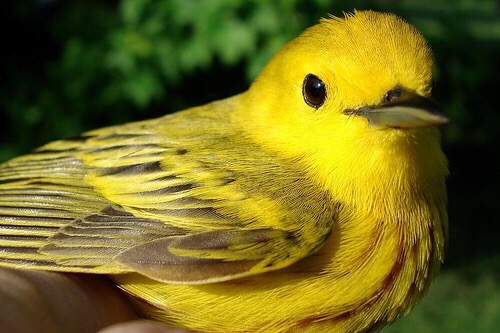
Prothonotary Warbler, Protonaria citrea

The Prothonotary Warbler, Protonaria citrea, breeds in hardwood swamps and forested lakeshores of the southeastern United States and is named for the scribes (prothonotaries) in the Roman Catholic Church who wore golden, hooded robes. Dubbed the Golden Swamp Warbler by John James Audubon, it is the only eastern warbler to nest in tree cavities, often using the excavated holes of Downy Woodpeckers and building mossy nests in trees near or over standing water.

Adults forage in low foliage for aquatic insects, snails, flies, beetles and spiders.
Because the prothonotary warbler is extremely habitat specific, habitat loss (wooded wetlands in the southeastern US and mangrove swamps of Latin America) may cause this species to decline.


No matter where you might be on the birding curve—whether you’ve learned the prothonotary’s ringing call or have never even heard of such a bird, whether you’ve mastered all the species’ migration routes or are still fumbling to find the focus wheel of your binoculars—the Midwest Birding Symposium has something in it for YOU!
There’s no better way to improve your skills, than to put yourself smack in the middle of a bunch of better birders—experts who are passionate about sharing something they love with another and super-nice folks who fondly remember exactly where they were when someone showed them their first life birds.
It’s not too late to get registered.
You’ll be surprised how much fun birds and birders can be!
I’d love to see you there!

Official 2011 Midwest Birding Symposium Blogger

Stumble Upon Toolbar

Monday, August 1, 2011

Heat

Like many others, I’ve been kept off the trail for days by this extreme heat--a wave so wide-ranging and long-lasting that I’m hard-pressed to find a direction to explore, a place escaping the blanket of humidity that, each day by dinnertime, catapults the heat index well above 100 degrees. Waiting out its wrath from within my air-conditioned cocoon, the only exercise I’ve undertaken in these last days has been little more than wading through a backlog of images.

Twig-rush, Cladium mariscoides
(a sedge)

I easily recall an equally warm summer day at Cedar Bog.
Though the comfort index was much greater weeks ago, lacking the humidity of late July, each retreat into the shaded woods from the blazing sun above the boardwalk was a welcome respite. Although the greatest attraction of this fen, for me, would be the sedge meadows, these wet woods hold their own allure in the shadow and light. Tall, straight stands of tulip poplar mingle with a dense growth of white cedar and black ash. Sprawling arms of poison sumac tempt the unknowing for a touch. And the faded forms of spring’s first green, skunk cabbage, now lie lazily on the dark, rich soil.

Can you find the spider in the picture above?

Common Fishing Spider, Dolomedes tenebrosus

Just in front of me, a large fishing spider drops quickly on a long thread and hangs, revolving slowly, at eye level. Well-camouflaged against the backdrop of trees in this dim interior space, her silver cord runs up to a tulip bough and catches what little light passes through the leafy canopy to the boardwalk below.

Seaside Arrowgrass, Triglochin maritima
in the sedge meadow

Bright light ahead indicates the first brief patch of sedge meadow. These open areas, bathed in just several inches of cool, crystalline water, are filled with a tangle of sedges, grasses and forbs and hide one of Cedar Bog’s most beloved summer citizens—the Elfin Skimmer dragonfly. Endangered in Ohio and known in only 3 sites statewide, this smallest of North American dragonflies at less than an inch in length is a tiny relative of the much larger and more common Common Whitetail, often seen cruising the edge of my pond in great numbers for months each summer.

Can you find the tiny dragonfly?

Elfin Skimmers on the other hand, are found only in bogs and fens, and then, in only select isolated communities. Almost impossible to spot at rest, the yellow- and black-striped females are easily overlooked in flight as well, looking more like wasps than dragonflies.

Elfin Skimmer, Nannothemis bella
female above
male below


Kneeling down on the heated boards and scanning the sedge mat, I am finally able to see several bluish elfin males barely clearing the tips of the stems as they flit from post to post, patrolling tiny, invisibly-marked territories one foot from the ground. From this angle, nose to the ground and leaning as far into the meadow as I dare, while still being firmly planted on the boardwalk, I notice that there’s even a pair in a mating wheel!

Elfin Skimmer dragonflies in mating wheel.

They’ll live out their lives right here, as countless visitors walk past--never straying from this sedge meadow, leaving eggs that will hatch into larvae and feed in the very same shallow and cool, clear water of this protected fen.
Most will never even see them.

Grass Pink in the Sedge Meadow

Another shaded section soon empties once more into a sunny sedge meadow. Through the dense stems, spots of brilliant pink peek out from above pools of shallow water. This is Grass Pink, an orchid, whose presence here with the ferns and sedges and grasses, indicates high quality ground water.

Grass Pink, Calopogon tuberosus

More than just another pretty face, this master of deception presents its flower upside down, as compared to other orchids, luring bees to its tempting upper lip, but offering no reward of nectar or pollen. The baffled bee falls backward onto the stigma (reproductive part of the plant) as the attractive upper lip drops down under its weight, and pollen on his back pollinates the flower. With a closer look, you can see how this ploy would work; from a distance, they’re nothing more than pretty spots of pink, barely standing out against a sunny meadow.

Grass Pink, Calopogon tuberosus

A couple emerges from the shaded path in the woods and hurriedly walks past me, continuing their course along the trail. Perhaps they’ve seen this all before—
the rare, tiny dragonflies,
the clever orchids peeking from the grass.
But I would hazard a guess that they have not.
Not for lack of time, nor retreat from the heat, nor lack of knowledge that these things exist—for the bounty of rarities found in Cedar Bog is well-proclaimed.
But for the very reason that tiny dragonflies and clever flowers have in this day become a rarity—
to many, those things just don’t matter... enough.


Stumble Upon Toolbar

Wednesday, July 13, 2011

Another helping of Botany, anyone?

Purple Coneflower, Echinacea purpurea

The Midwest Native Plant Symposium brought together a combination of botanical experts, local native plant vendors and plant/nature enthusiasts for a weekend of wild activities of all sorts. Mornings began with bird walks, just as the sun was making its way onto the sprawling greenscape of Mount Saint John. As anyone with an interest in our birds or bugs soon discovers, they owe their existence to an intimate connection with our native plants as well, which provide that broad base to the food chain, determining and supporting all life above it. Nights wrapped up with moonlit jaunts along the wooded trails or between plots of prairie in search of insects roused as darkness fell--assorted crickets, beetles, moths and katydids. And between those outdoor, exploratory pursuits, a choice of classroom sessions covered everything from Ohio’s champion trees to the tiniest parts of a flower.


A dinner plate scattered with flowers and a hand lens wrapped in its long, black cord waited on each chair in David Brandenburg’s classroom. I had met Dr. Brandenburg before and carry his invaluable guide to wildflowers wherever I go. This morning, we would take a closer look at the Aster family—look more deeply into the largest family of flowering plants, easily recognized by having an inflorescence (flower head) composed of many florets (smaller flowers, each with distinct characteristics). Easily recognized, yes--but perhaps not so easily understood.
There’s a lot going on beyond what the untrained eye can see while watching from the garden’s edge. Breaking open those beautiful flower heads and jumping in with a hand lens is the only way even the experts are able to sort it all out!

Dr. David Brandenburg serves up a plateful of Asters

Some of the most common and well-known flowers belong to the Aster family, Asteraceae (or Compositae)--daisies, dandelions, and thistles—and even to the naked eye, their differences are pretty easy to see. What gives these “flowers” their distinctly recognizable profiles, however, are the tiny florets composing each inflorescence—3 types, which, when arranged in different combinations, create 3 very different looking flower heads.


Beneath the hand lens, the familiar flower parts we all learned in grade school suddenly appear on the face of the daisy. Packed by the hundreds into its center, there are small flowers, each with a tube of 5 united yellow petals and a column of fused anthers. A hair-like style in the center of each emerges and splits into two delicate branches. Each of these minute florets, described as tubular or regular, is called a disc flower and possesses both male and female parts.
But, around the daisy’s white edge, the florets look very different. Strap-like or irregular, these small flowers have 5 united petals, as well, though they projects as a unit only to one side. They are known as ray flowers, which may be female (as in a daisy) or, in some species, neutral, acting only as a flag to attract a pollinator to other non-sterile florets within the flower head. (sunflowers)
Ligulate florets, like disc florets, contain both male and female flower parts, the column of anthers and branched style, but, like ray florets, have fused petals appearing as a single strap.


Combinations of florets create the 3 basic flower heads. The daisy, a radiate head, is made up of a field of disc flowers surrounded by a ring of ray flowers. Thistles are composed of disc flowers entirely and illustrate the discoid head. While dandelions, composed entirely of ligulate flowers, are said to have a ligulate head.


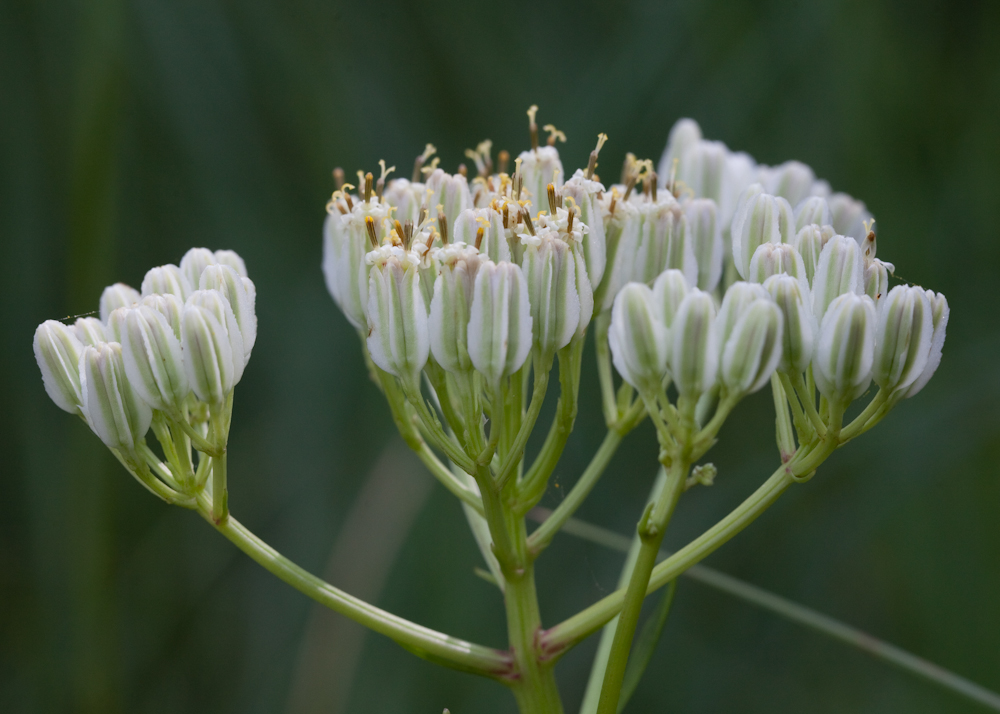
Fen Indian-Plantain, Arnoglossum plantagineum

It's in the Aster family--look closely at the tiny florets making up each 5-part flower! The photo above shows each floret's petals still tightly closed.
Click photos for a closer look!

Now, the fine white petals have curled back to reveal the columns of anthers (those brown things sticking out). Some even show the 2-part styles which have emerged through the columns to tower above them. The orange coloring at the anthers' tips is pollen that is pushed out through the top of the column by the style from below as it lengthens and grows within the column. Cool, huh? And, oh, so tiny!

flowers have passed

So,... what of all these technical terms? Is it simply to sound smart and impress others with a newly-learned, secret language?

Nope, not at all.
Take one peek into any serious plant manual, and you’ll soon understand the importance of getting a grasp on botanical language. With over 22,000 species of asters alone worldwide, subtle differences separate similar species. Keys are written and flowers described with consistent terms to eliminate confusion.
Without concise language, navigating a dichotomous key would be like attempting to follow a roadmap through New York City—one without any street names.
In no time at all, everyone would be lost.

Jim McCormac, our trip leader, quizzes us about the flower heads of asters

The next day, in a trip to Cedar Bog, the classroom language was reinforced in the field. Cedar Bog is far more than a collection of asters, though, with scores of rare or endangered plants at every turn along the 1-mile boardwalk. And, as you’d expect in an area so botanically diverse, we found far more than native plants.

Steve McKee and Cheryl Harner assist from the back

It all starts with the native plants, though.
And our understanding of them and their significance to everything else.


Cheryl Harner and Derek Hennen pause to enjoy the cool breeze from the shade of Northern White Cedars

For contrast, a Michigan Lily, Lilium michiganense--
NOT an aster, no hand lens needed here!


The National Wildlife Federation
Field Guide to Wildflowers of North America
by David M. Brandenburg

Thank you, David, for tweaking this explanation
and straightening out all these florets in my mind!


Stumble Upon Toolbar

Wednesday, October 14, 2009

Manistique River


The shore of the Manistique was a welcome sight.
A steep descent over a narrow, one-lane drive, deeply furrowed and piled high with loose sand, that would happily swallow an axle of a less-than-confident-driver’s vehicle, committed us to spending some time here—at least until we could locate another way out. But, we were pleased to have found it, the public access point for the river running through the southeastern quadrant of the refuge (Seney NWR) buried at what seemed to be the end of the earth in the an empty, rustic campground on Michigan’s Upper Peninsula.
We dropped Red Canoe from the roof, loaded her with our bags for the day and pushed off onto the amber water.


Our plan was to travel upstream, paddling against the strong current as far as we were able, rewarding ourselves with the gentle float home reserved for the end of the day. The sky was blue and air warming quickly under brilliant September sun.


The Manistique River is rimmed by dense woods and runs through areas described as rich conifer swamp, patterned fen and dry mesic northern forest—damp and dark beyond their edges, fragrant with white or jack pine and white cedar. Beneath a thin layer of organic soil, is sand—pushed into large, rippled bars that rose beneath us in the slow-moving river margins or fell away, carved into deep pools by a fast-running channel, but leaving the water with a clarity we never experience at home, in southwestern Ohio’s murky rivers and lakes lined with silt and clay.


There’s a quiet here—an almost audible heartbeat. A fullness, a richness caught within, set apart from roads and cars, homes and voices, wrapped in the insulative sheath of the wet woods.
From behind us, came the rattling call of a pair of cranes, who soon appeared above us in the small slit of now clouded sky where the dense trees parted and allowed the river room, and then flew on toward the interior of the refuge, until we were alone on the water in Red Canoe, with only the proprietary scolding of the red squirrels.


We rested for lunch on a sandy bank, where I crawled up and disappeared underneath the lacy branches of a stand of hemlock, and sat on a soft needle carpet peeking out to the water below. In the stillness of the woods behind me, its rich history crept quietly in the shadows, with names like Nokomis and Hiawatha, then disappeared, as I turned to look, behind a tree.
A distance down the shore, I discovered a track—large and with long claws, that sent me stumbling back to Red Canoe—back onto the wide, flowing amber water, where by now, our cell phone had became nothing more than an expensive timepiece, zipped into a waterproof pocket.


Halfway through the afternoon, dark clouds brought a chill beneath them and a wave of light rain that chased us into the shelter of a large white cedar, which reached out over the river, spreading like a giant umbrella. From there we waited, with each pause, more certain it would soon be finished.

Until we emerged, braving the last spitting droplets to float easily back toward the campsite.


Under the magic of a fine mist floating just above the river, it appeared as it could have been, ages ago.
The mark of our presence, but one footprint.

footprints
(click to enlarge)


Eastern White Cedar


View more ABC Wednesdays here!


Stumble Upon Toolbar