Showing posts with label Cedar Bog. Show all posts

Monday, August 1, 2011

Heat

Like many others, I’ve been kept off the trail for days by this extreme heat--a wave so wide-ranging and long-lasting that I’m hard-pressed to find a direction to explore, a place escaping the blanket of humidity that, each day by dinnertime, catapults the heat index well above 100 degrees. Waiting out its wrath from within my air-conditioned cocoon, the only exercise I’ve undertaken in these last days has been little more than wading through a backlog of images.

Twig-rush, Cladium mariscoides
(a sedge)

I easily recall an equally warm summer day at Cedar Bog.
Though the comfort index was much greater weeks ago, lacking the humidity of late July, each retreat into the shaded woods from the blazing sun above the boardwalk was a welcome respite. Although the greatest attraction of this fen, for me, would be the sedge meadows, these wet woods hold their own allure in the shadow and light. Tall, straight stands of tulip poplar mingle with a dense growth of white cedar and black ash. Sprawling arms of poison sumac tempt the unknowing for a touch. And the faded forms of spring’s first green, skunk cabbage, now lie lazily on the dark, rich soil.

Can you find the spider in the picture above?

Common Fishing Spider, Dolomedes tenebrosus

Just in front of me, a large fishing spider drops quickly on a long thread and hangs, revolving slowly, at eye level. Well-camouflaged against the backdrop of trees in this dim interior space, her silver cord runs up to a tulip bough and catches what little light passes through the leafy canopy to the boardwalk below.

Seaside Arrowgrass, Triglochin maritima
in the sedge meadow

Bright light ahead indicates the first brief patch of sedge meadow. These open areas, bathed in just several inches of cool, crystalline water, are filled with a tangle of sedges, grasses and forbs and hide one of Cedar Bog’s most beloved summer citizens—the Elfin Skimmer dragonfly. Endangered in Ohio and known in only 3 sites statewide, this smallest of North American dragonflies at less than an inch in length is a tiny relative of the much larger and more common Common Whitetail, often seen cruising the edge of my pond in great numbers for months each summer.

Can you find the tiny dragonfly?

Elfin Skimmers on the other hand, are found only in bogs and fens, and then, in only select isolated communities. Almost impossible to spot at rest, the yellow- and black-striped females are easily overlooked in flight as well, looking more like wasps than dragonflies.

Elfin Skimmer, Nannothemis bella
female above
male below


Kneeling down on the heated boards and scanning the sedge mat, I am finally able to see several bluish elfin males barely clearing the tips of the stems as they flit from post to post, patrolling tiny, invisibly-marked territories one foot from the ground. From this angle, nose to the ground and leaning as far into the meadow as I dare, while still being firmly planted on the boardwalk, I notice that there’s even a pair in a mating wheel!

Elfin Skimmer dragonflies in mating wheel.

They’ll live out their lives right here, as countless visitors walk past--never straying from this sedge meadow, leaving eggs that will hatch into larvae and feed in the very same shallow and cool, clear water of this protected fen.
Most will never even see them.

Grass Pink in the Sedge Meadow

Another shaded section soon empties once more into a sunny sedge meadow. Through the dense stems, spots of brilliant pink peek out from above pools of shallow water. This is Grass Pink, an orchid, whose presence here with the ferns and sedges and grasses, indicates high quality ground water.

Grass Pink, Calopogon tuberosus

More than just another pretty face, this master of deception presents its flower upside down, as compared to other orchids, luring bees to its tempting upper lip, but offering no reward of nectar or pollen. The baffled bee falls backward onto the stigma (reproductive part of the plant) as the attractive upper lip drops down under its weight, and pollen on his back pollinates the flower. With a closer look, you can see how this ploy would work; from a distance, they’re nothing more than pretty spots of pink, barely standing out against a sunny meadow.

Grass Pink, Calopogon tuberosus

A couple emerges from the shaded path in the woods and hurriedly walks past me, continuing their course along the trail. Perhaps they’ve seen this all before—
the rare, tiny dragonflies,
the clever orchids peeking from the grass.
But I would hazard a guess that they have not.
Not for lack of time, nor retreat from the heat, nor lack of knowledge that these things exist—for the bounty of rarities found in Cedar Bog is well-proclaimed.
But for the very reason that tiny dragonflies and clever flowers have in this day become a rarity—
to many, those things just don’t matter... enough.


Stumble Upon Toolbar

Wednesday, July 13, 2011

Another helping of Botany, anyone?

Purple Coneflower, Echinacea purpurea

The Midwest Native Plant Symposium brought together a combination of botanical experts, local native plant vendors and plant/nature enthusiasts for a weekend of wild activities of all sorts. Mornings began with bird walks, just as the sun was making its way onto the sprawling greenscape of Mount Saint John. As anyone with an interest in our birds or bugs soon discovers, they owe their existence to an intimate connection with our native plants as well, which provide that broad base to the food chain, determining and supporting all life above it. Nights wrapped up with moonlit jaunts along the wooded trails or between plots of prairie in search of insects roused as darkness fell--assorted crickets, beetles, moths and katydids. And between those outdoor, exploratory pursuits, a choice of classroom sessions covered everything from Ohio’s champion trees to the tiniest parts of a flower.


A dinner plate scattered with flowers and a hand lens wrapped in its long, black cord waited on each chair in David Brandenburg’s classroom. I had met Dr. Brandenburg before and carry his invaluable guide to wildflowers wherever I go. This morning, we would take a closer look at the Aster family—look more deeply into the largest family of flowering plants, easily recognized by having an inflorescence (flower head) composed of many florets (smaller flowers, each with distinct characteristics). Easily recognized, yes--but perhaps not so easily understood.
There’s a lot going on beyond what the untrained eye can see while watching from the garden’s edge. Breaking open those beautiful flower heads and jumping in with a hand lens is the only way even the experts are able to sort it all out!

Dr. David Brandenburg serves up a plateful of Asters

Some of the most common and well-known flowers belong to the Aster family, Asteraceae (or Compositae)--daisies, dandelions, and thistles—and even to the naked eye, their differences are pretty easy to see. What gives these “flowers” their distinctly recognizable profiles, however, are the tiny florets composing each inflorescence—3 types, which, when arranged in different combinations, create 3 very different looking flower heads.


Beneath the hand lens, the familiar flower parts we all learned in grade school suddenly appear on the face of the daisy. Packed by the hundreds into its center, there are small flowers, each with a tube of 5 united yellow petals and a column of fused anthers. A hair-like style in the center of each emerges and splits into two delicate branches. Each of these minute florets, described as tubular or regular, is called a disc flower and possesses both male and female parts.
But, around the daisy’s white edge, the florets look very different. Strap-like or irregular, these small flowers have 5 united petals, as well, though they projects as a unit only to one side. They are known as ray flowers, which may be female (as in a daisy) or, in some species, neutral, acting only as a flag to attract a pollinator to other non-sterile florets within the flower head. (sunflowers)
Ligulate florets, like disc florets, contain both male and female flower parts, the column of anthers and branched style, but, like ray florets, have fused petals appearing as a single strap.


Combinations of florets create the 3 basic flower heads. The daisy, a radiate head, is made up of a field of disc flowers surrounded by a ring of ray flowers. Thistles are composed of disc flowers entirely and illustrate the discoid head. While dandelions, composed entirely of ligulate flowers, are said to have a ligulate head.


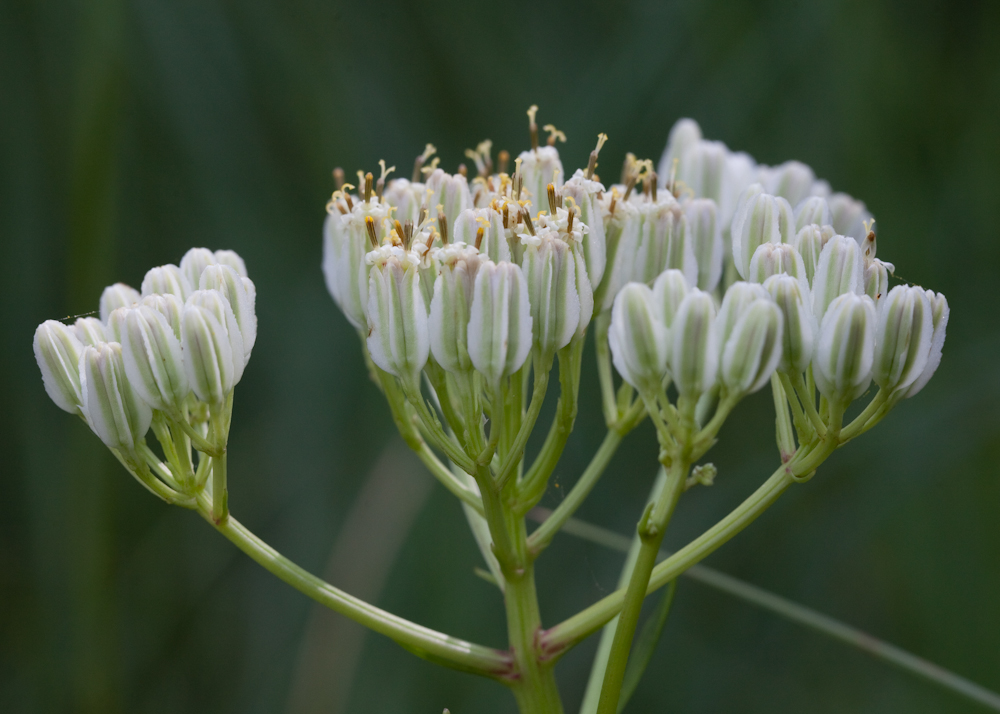
Fen Indian-Plantain, Arnoglossum plantagineum

It's in the Aster family--look closely at the tiny florets making up each 5-part flower! The photo above shows each floret's petals still tightly closed.
Click photos for a closer look!

Now, the fine white petals have curled back to reveal the columns of anthers (those brown things sticking out). Some even show the 2-part styles which have emerged through the columns to tower above them. The orange coloring at the anthers' tips is pollen that is pushed out through the top of the column by the style from below as it lengthens and grows within the column. Cool, huh? And, oh, so tiny!

flowers have passed

So,... what of all these technical terms? Is it simply to sound smart and impress others with a newly-learned, secret language?

Nope, not at all.
Take one peek into any serious plant manual, and you’ll soon understand the importance of getting a grasp on botanical language. With over 22,000 species of asters alone worldwide, subtle differences separate similar species. Keys are written and flowers described with consistent terms to eliminate confusion.
Without concise language, navigating a dichotomous key would be like attempting to follow a roadmap through New York City—one without any street names.
In no time at all, everyone would be lost.

Jim McCormac, our trip leader, quizzes us about the flower heads of asters

The next day, in a trip to Cedar Bog, the classroom language was reinforced in the field. Cedar Bog is far more than a collection of asters, though, with scores of rare or endangered plants at every turn along the 1-mile boardwalk. And, as you’d expect in an area so botanically diverse, we found far more than native plants.

Steve McKee and Cheryl Harner assist from the back

It all starts with the native plants, though.
And our understanding of them and their significance to everything else.


Cheryl Harner and Derek Hennen pause to enjoy the cool breeze from the shade of Northern White Cedars

For contrast, a Michigan Lily, Lilium michiganense--
NOT an aster, no hand lens needed here!


The National Wildlife Federation
Field Guide to Wildflowers of North America
by David M. Brandenburg

Thank you, David, for tweaking this explanation
and straightening out all these florets in my mind!


Stumble Upon Toolbar