Showing posts with label caterpillars. Show all posts

Tuesday, August 17, 2010

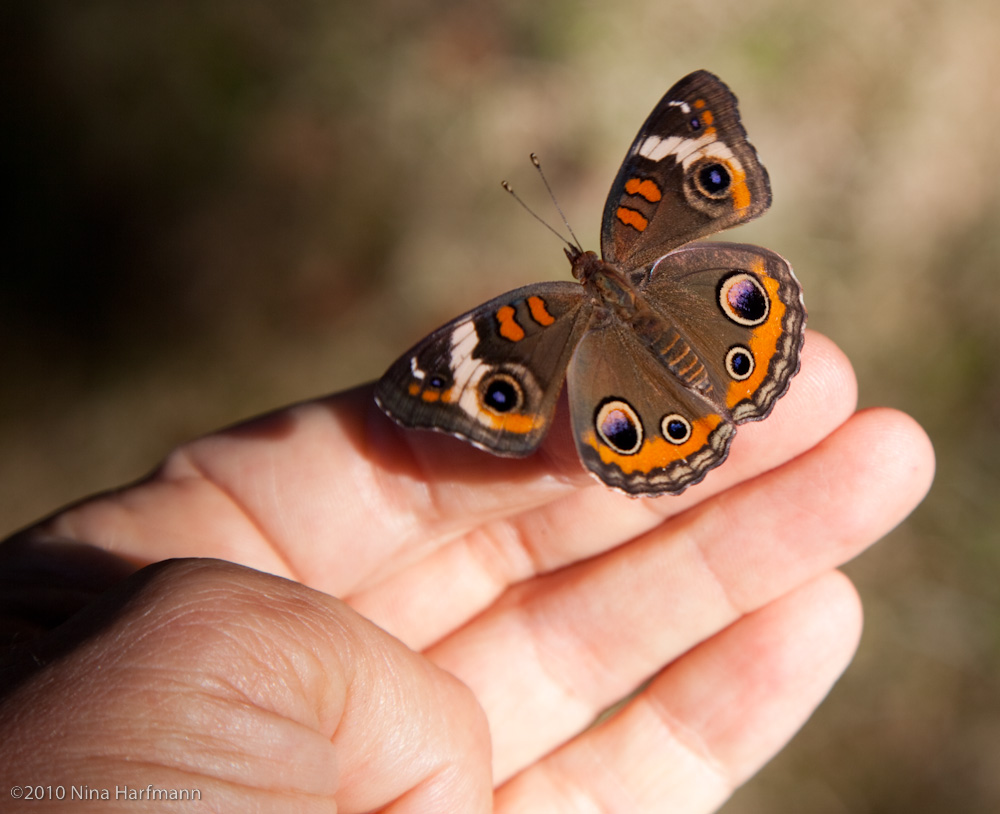
Beautiful Buckeye

Common Buckeye, Junonia coenia

There is a gentle flutter against the glass. On this cool morning, each of a handful of butterflies begins its life upon wings and waits to fly in the first warming rays of the sun.
They’re my beautiful Buckeyes—found as caterpillars just several days before, as I walked the mowed path ringing a summer field filled with riotous wildflowers.
Absorbed in a torrent of insect song brought on by that steamy morning, I had walked into their midst, barely noticing their wanderings below on a patch of path 6 feet wide and stretching 15 feet down the trail. Their colorful but dark, softly-spined wormy bodies fed furiously at my feet on the short stems of plantain interspersed with cut grass.

Common Buckeye caterpillar on plantain

Tiptoeing between them and picking up one after another, I soon had a handful of brilliant wriggling worms reluctant to remain in my cupped hands while I hurriedly headed for home. Basically a solitary caterpillar, this spot of lawn had apparently been chosen again and again by an egg-laying adult, as she flitted from one food plant to the next—a single green egg left each time. And scattered densely along my daily walkway, I was sure this caterpillar nursery would meet with an unfortunate end.

Common Buckeye caterpillar on Ruellia

Safely tucked into my glass tank enclosure and stuffed with fresh sprigs of Ruellia and assorted plantains, days later 31 cryptic chrysalides hung from silken tethers around its lid.


Not yet warmed enough to take to the air, each turns, open-winged to sit in a spot of sunshine, then lifts from my finger and floats across the field.


Stumble Upon Toolbar

Tuesday, December 8, 2009

Underneath it all


It doesn’t look like much, perhaps even an oversight—the terrarium left sitting on the front porch stoop, while others’ homes are now tidied for Christmas. But, the frosted glass and pile of leaves within are there, just as I like them.
Something’s going on--underneath it all.

Giant Leopard Moth caterpillar


As summer days were waning and butterflies had moved on, I found a hairy caterpillar wearing his woollies for winter—the prickly, black bristles that sprout from bumpy knobs in rings winding around his body. Bands of red skin flashed through them, as he bent and wiggled along. Intrigued, I kept him—and placed him with three more in the terrarium that always waits, ready, for something to come creeping.

Swainson's Thrush watching

For several warm weeks, they ate. And I was happy to bring them their favorite—short stems of that unwelcome honeysuckle, with the tender, fresh leaves at the tip. Then the days turned sharply colder and from the tree above, leaves fell in piles to the ground. Slower and slower, each day, they moved. Until they one day, I found them curled head to tail, resting in slight depressions they’d found or made for themselves in the rich, dark dirt I’d given them.


I peek in on them now, from day to day, as wintry frost lines the windows of their room.
Underneath the leafy blanket, next year's beauty sleeps.


View more ABC Wednesdays here!

Stumble Upon Toolbar

Saturday, August 22, 2009

Who grows there?

Sand Vine, Cynanchum laeve

I could blame it on the weather.
Heaven knows it’s rained more this summer than ever before, or so it would seem. Weekly storms have left the ground saturated. And cool temperatures have taken little of the moisture away. The tomato plants, lush and leggy, have barely held their fruit for the time it takes to ripen, many times dropping heavy, orange orbs onto the damp dirt to rot, hidden from view in the coiling, bushy branches wrapping within each metal cage.
I could blame it on the woodchucks--all ten, who fed handsomely on dinners seasoned with freshly snipped dill and cilantro, after ducking beneath the electric fence to gorge on green beans and decapitate the tender tops of sweet potato plants each time the roots sent fresh growth out from each hopeful hill.
Or, I could blame it on my life, that teases me into thinking I have time to devote to a garden, remembering the tending and doting one demands--then picks up and runs off laughing, never looking backward over its shoulder to see that I haven’t kept up.
Truth is, all three have come together this year to leave us with mountains of zucchini and cucumbers, a nice plot of basil and little else.

So, determined to rescue the remnants of what had been 2 rows of green beans, now lying mauled and muddied beneath a heavy blanket of vines creeping in from the edge, I set off toward the plot, clippers in hand. Julie had heard that a heavy pruning of the plants could produce a second crop and was giving it a try.
For me, any crop, this year, would be welcome.

Snipping along, nipping and tucking my way down each row, bean stems here, vine stems there, I amassed quite a pile—tangled and thrown onto the grass, the few old, woody beans sadly hanging. And marveled at my new creation—a barren, brown strip. The 2 rows of plants, nothing more than short stems.

Sand Vine, Cynanchum laeve
Do you see what I see?
(click to enlarge)

The vines, always eyeing an open space to conquer, had also found the corner stake, and had wound around and around each other up its metal bar, extending a ropey arm to the sky. From my spot in the grass, where I sat, pleased, now, in my new hope for the ravaged garden, I could see hundreds of tiny golden aphids along its length, each elbowing its neighbor, nodding and dipping as they sipped from the tender stem.
And a teeny, tiny stripy one, that wasn’t an aphid at all.

I knew, even as I rose to look more closely at what was barely there, what moved slowly along the stem.
His fine black and yellow-striped body.
The delicate whiplashes on either end.
Yes, the monarch caterpillars I had hoped to find in the milkweed patch beside the pond, were feeding here, instead, on the Sand Vine--and I had just plowed through their nursery.

Monarch caterpillars feeding on Sand Vine, Cynanchum laeve

Carefully, I unraveled the tangled vines from the pile tossed beside the garden, my eyes scanning for evidence of chewed leaves and tiny striped bodies and found two more, untouched by the trimming, wandering aimlessly amidst the wilting stems.
Gently, I inserted a new leaf beneath the silken attachments of their tiny feet, and in minutes, each inched forward onto their new climbing host plant.
In total, now seven.

No cilantro, no dill, no sweet potatoes, no beans—
but the garden’s just fine, if I might say so.
Some, in fact, say it's divine.

Monarch butterfly depositing egg on Sand Vine, Cynanchum laeve

Stumble Upon Toolbar

Wednesday, September 3, 2008

Third Strike

Our vegetable garden has suffered this year.

Weeding was replaced by wedding.
And soon, other home projects that demand we make progress in the few short summer months each year were underway. While already, the repairs made 15 years ago upon our arrival have been undone—others, yet unstarted, wait.
But, as much as the greedy old house steals time, we would not have it any other way.
“Building character,” we call it, and hammer away at our dream.

Rebuilding porches and repair to brick

Repointing around old shutter dog

At the edge of the woods, a small oak tree I walk past each day has suffered, too.
First, nearly consumed by a hoard of Datana caterpillars—arching into their defensive postures with the slightest nudge of the branch.

Datana sp.
before and after

Then, nibbled and trimmed by the bagworm, days later, his house decorated by the few remaining scraps he could find.

Bagworm feeding on oak
Thyridopteryx sp.

Today, what may be the final blow. Still too small to be seen well, but flattened against the bare narrow stems where others have chewed, still more have arrived to feed.


With each assault, I worry that this young specimen that dared step forward into the field may not survive. The others tower behind him, seemingly unaffected.
A sacrifice, perhaps?

A large unruly plant has sprouted from my compost pile and set forth across the lawn.
We mow around it.
Its leafy greenness hides my gardening sins.
And bears the only tomatoes we may see this year.

Stumble Upon Toolbar

Thursday, August 28, 2008

Woolly Bear


Soft feet crossing heat
as cars and trucks fly past them.

Oh, these bears can run!


Yellow Woolly Bear crossing road


Stumble Upon Toolbar

Tuesday, August 26, 2008

It's in the Bag


So, how cool is this!?
A caterpillar that carries his own silk spindle-shaped stocking, decorated with leaf clippings he’s gathered, easily overlooked amidst the oak branches. He moves deftly along, leaf by leaf, feeding and resting--ducking quickly inside and closing the opening if disturbed.


Bagworms are the larval stage of a generally unseen moth, hanging in camouflaged houses – covered with everything from sticks and berries to needles and grains of sand.

Lacy black filigree against a pale white face peek out at me, and six grasping legs emerge from the safety of their shelter. The long, soft and tender wrinkled body behind stays within—only stretching to reach what he cannot grasp.


Soon he will fasten his stocking securely to the branch, tie down the opening and pupate. If male, he will emerge as a winged adult moth. The wingless females remain inside their silk enclosure, and after mating, leave eggs behind for spring.

Certainly, this little character, camped out on an oak branch stuffed neatly in a vase on my kitchen table wins this year’s “cool creature award.”
He’s definitely got it in the bag!

Thyridopteryx sp. on silk

Bagworm house of oak leaves


Thyridopteryx sp.
Can you see the bristles on his abdominal appendages?
They keep the bag from slipping off.


Stumble Upon Toolbar

Wednesday, August 20, 2008

Captive Caterpillar on the Run(way)


I persuaded my captive caterpillar to model his flowery outfit,
his runway an upturned pencil in the vase where his flower had been.


Synchlora sp. on Queen Anne's Lace

Can you find him here?
Click on images to enlarge

Synchlora caterpillars disguise themselves within the flowers on which they feed by adorning their bodies with flower pieces cut from the same plant. As old pieces wilt and turn brown, they are replaced with new, making it almost impossible for prey to find them unless they move.

Stumble Upon Toolbar