Purple Coneflower, Echinacea purpurea
A dinner plate scattered with flowers and a hand lens wrapped in its long, black cord waited on each chair in David Brandenburg’s classroom. I had met Dr. Brandenburg before and carry his invaluable guide to wildflowers wherever I go. This morning, we would take a closer look at the Aster family—look more deeply into the largest family of flowering plants, easily recognized by having an inflorescence (flower head) composed of many florets (smaller flowers, each with distinct characteristics). Easily recognized, yes--but perhaps not so easily understood.
There’s a lot going on beyond what the untrained eye can see while watching from the garden’s edge. Breaking open those beautiful flower heads and jumping in with a hand lens is the only way even the experts are able to sort it all out!
 Dr. David Brandenburg serves up a plateful of Asters
Some of the most common and well-known flowers belong to the Aster family, Asteraceae (or Compositae)--daisies, dandelions, and thistles—and even to the naked eye, their differences are pretty easy to see. What gives these “flowers” their distinctly recognizable profiles, however, are the tiny florets composing each inflorescence—3 types, which, when arranged in different combinations, create 3 very different looking flower heads.


Beneath the hand lens, the familiar flower parts we all learned in grade school suddenly appear on the face of the daisy. Packed by the hundreds into its center, there are small flowers, each with a tube of 5 united yellow petals and a column of fused anthers. A hair-like style in the center of each emerges and splits into two delicate branches. Each of these minute florets, described as tubular or regular, is called a disc flower and possesses both male and female parts.
But, around the daisy’s white edge, the florets look very different. Strap-like or irregular, these small flowers have 5 united petals, as well, though they projects as a unit only to one side. They are known as ray flowers, which may be female (as in a daisy) or, in some species, neutral, acting only as a flag to attract a pollinator to other non-sterile florets within the flower head. (sunflowers)
Ligulate florets, like disc florets, contain both male and female flower parts, the column of anthers and branched style, but, like ray florets, have fused petals appearing as a single strap.

Combinations of florets create the 3 basic flower heads. The daisy, a radiate head, is made up of a field of disc flowers surrounded by a ring of ray flowers. Thistles are composed of disc flowers entirely and illustrate the discoid head. While dandelions, composed entirely of ligulate flowers, are said to have a ligulate head.
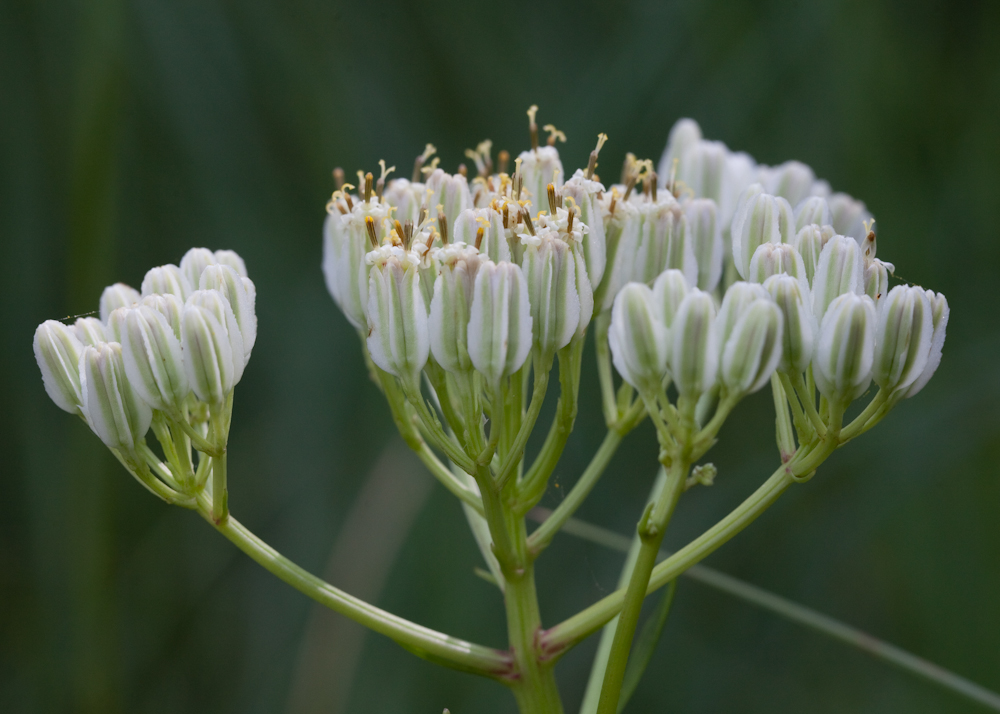 Fen Indian-Plantain, Arnoglossum plantagineum
 It's in the Aster family--look closely at the tiny florets making up each 5-part flower! The photo above shows each floret's petals still tightly closed.
Click photos for a closer look!
 Now, the fine white petals have curled back to reveal the columns of anthers (those brown things sticking out). Some even show the 2-part styles which have emerged through the columns to tower above them. The orange coloring at the anthers' tips is pollen that is pushed out through the top of the column by the style from below as it lengthens and grows within the column. Cool, huh? And, oh, so tiny!
 flowers have passed
So,... what of all these technical terms? Is it simply to sound smart and impress others with a newly-learned, secret language?
Nope, not at all.
Take one peek into any serious plant manual, and you’ll soon understand the importance of getting a grasp on botanical language. With over 22,000 species of asters alone worldwide, subtle differences separate similar species. Keys are written and flowers described with consistent terms to eliminate confusion.
Without concise language, navigating a dichotomous key would be like attempting to follow a roadmap through New York City—one without any street names.
In no time at all, everyone would be lost.
 Jim McCormac, our trip leader, quizzes us about the flower heads of asters
 Steve McKee and Cheryl Harner assist from the back
And our understanding of them and their significance to everything else.
 Cheryl Harner and Derek Hennen pause to enjoy the cool breeze from the shade of Northern White Cedars
 For contrast, a Michigan Lily, Lilium michiganense--
NOT an aster, no hand lens needed here!
 The National Wildlife Federation
Field Guide to Wildflowers of North America
by David M. Brandenburg
Thank you, David, for tweaking this explanation
and straightening out all these florets in my mind!





%20copy.jpg)