Showing posts with label butterflies. Show all posts

Tuesday, August 17, 2010

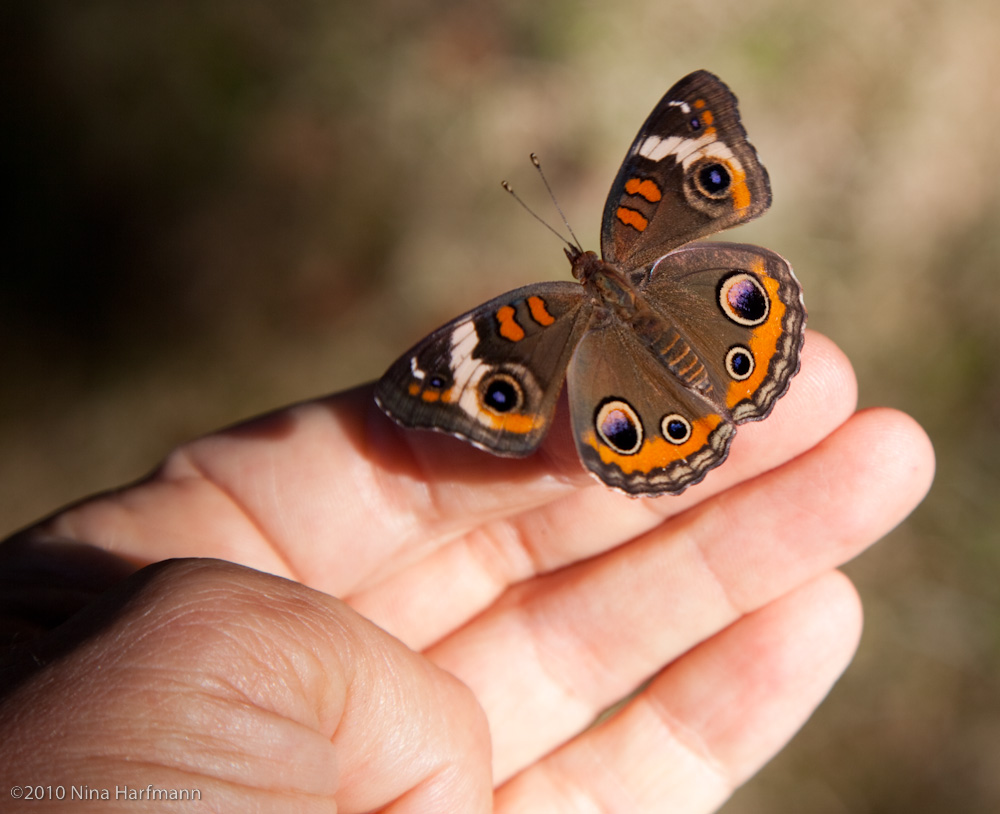
Beautiful Buckeye

Common Buckeye, Junonia coenia

There is a gentle flutter against the glass. On this cool morning, each of a handful of butterflies begins its life upon wings and waits to fly in the first warming rays of the sun.
They’re my beautiful Buckeyes—found as caterpillars just several days before, as I walked the mowed path ringing a summer field filled with riotous wildflowers.
Absorbed in a torrent of insect song brought on by that steamy morning, I had walked into their midst, barely noticing their wanderings below on a patch of path 6 feet wide and stretching 15 feet down the trail. Their colorful but dark, softly-spined wormy bodies fed furiously at my feet on the short stems of plantain interspersed with cut grass.

Common Buckeye caterpillar on plantain

Tiptoeing between them and picking up one after another, I soon had a handful of brilliant wriggling worms reluctant to remain in my cupped hands while I hurriedly headed for home. Basically a solitary caterpillar, this spot of lawn had apparently been chosen again and again by an egg-laying adult, as she flitted from one food plant to the next—a single green egg left each time. And scattered densely along my daily walkway, I was sure this caterpillar nursery would meet with an unfortunate end.

Common Buckeye caterpillar on Ruellia

Safely tucked into my glass tank enclosure and stuffed with fresh sprigs of Ruellia and assorted plantains, days later 31 cryptic chrysalides hung from silken tethers around its lid.


Not yet warmed enough to take to the air, each turns, open-winged to sit in a spot of sunshine, then lifts from my finger and floats across the field.


Stumble Upon Toolbar

Monday, July 19, 2010

No Less Lovely


While those behind the garden gate
on fiery plumes bent low do sway
and sip the wine of kings and queens,
beyond them yet a copper.

Whose tireless flight past fields grown high
beside this ditch down dusty road,
her fare in one brave plant remains uncut.
Alas, she is no less lovely.


Bronze Copper, Lycaena hyllus, female


The Bronze Copper, Lycaena hyllus, is a butterfly primarily of open wet areas. Although adults will take nectar readily from a variety of flowers, the caterpillar must feed on water dock, curled dock or knotweed--wetland plants often in short supply when wet areas are drained or filled. With the loss of wetlands, this butterfly is declining in many areas.

Stumble Upon Toolbar

Tuesday, July 14, 2009

Zebra Swallowtail

Cabbage White butterfly feeding at thistle

I caught just a glimpse of her,
skipping boldly through the field
on the long, striped wings I have waited for.

Coneflower in garden

But today, I cannot find her,
though at every other flower and stem,
wings lay open,
hungry mouths feed.

Skipper feeding at teasel

Little Wood-Satyr on goldenrod stem

I hope she will remember me,
the Paw-Paws planted,
just as she likes them,
in the shaded grove.

Three small trees.


Paw paws planted


Zebra Swallowtail, Eurytides marcellus

Just as Monarchs go with milkweed, so, too, do Zebra Swallowtails and the Paw-Paw tree.
As wooded areas are cleared, this native understory tree is often lost.
In April, hoping to attract Zebra Swallowtail butterflies, I planted 3 small trees.

View more ABC Wednesdays here!

Stumble Upon Toolbar

Thursday, June 4, 2009

The Waiting Field (SWF)

Corn Field

More rain just minutes away, still, the waiting field close enough for another day’s quick visit—open space and evening solitude, a welcome walk down the lane.
The weeds here, not yet tamed.

yellow rocket


butterweed
cressleaf groundsel

And, as it is each spring, for me to wonder as to what will replace this wildness, I hope for its turning, yet again—
for crops of corn or soy.
But, as each neighboring field is planted, and this one still stands under golden tops, acres across, I worry it may have seen its last season—sold for a greater price to one who will title it for what it once was, “Deerfield Crossing” or “Fox Run.”
I will always find the name, corn field, most satisfying.

Common Sooty Wings
at the road's edge


For more information on cressleaf groundsel, look here.

See more Skywatch here.

Stumble Upon Toolbar

Wednesday, August 13, 2008

Metamorphosis

It’s that time of year again. When they dust off the school buses, and the elementary building up the road begins to show signs of life once more.
It is time to go back to school.

I remember first-day jitters and my favorite lunch box. Kickball and the Pledge of Allegiance. And of course, hoping my desk would be close enough to the window ledge to be able to watch the caterpillars in glass boxes.
There were always caterpillars on the first day of school.


I found a small Black Swallowtail caterpillar on Queen Anne’s Lace in the field, recently hatched and still wearing his white saddle. Days later his plump green body nibbled hungrily beneath another umbel--the changes already beginning.


I snipped several stems of his favorite and carried them with me, home. A small glass vase keeps them fresh, as he eats and eats …and eats on our kitchen table.


Black Swallowtail caterpillar tethered to Ironweed

A day of stillness brings another change.


This time, his lovely chrysalis tethered by thin silken strands where his striped body hung the night before, as a newly furled leaf along the stem.


Shed caterpillar skin like a bunched up sock beneath him.
Faint lines upon green, trace the life changing within.


I see wings and eyes on a butterfly’s face.


Metamorphosis, a beautiful form evolving from behind the thinnest curtain, a child’s lesson never old.
A wonder of life to witness, each time, new.

Black Swallowtail chrysalis on Ironweed


Click photos to enlarge
Can you see his face and wings?


Shed skin showing head capsule

Stumble Upon Toolbar

Sunday, August 10, 2008

"Let's be careful out there"

I was drawn to her, as she to the flower.
A Spring Azure the size of a dime, sipping slowly from Boneset in the field of goldenrod. Another of the Gossamer-winged, another Blue, in a rare moment of rest.


I inched the camera slowly forward, catching a picture every several inches until I was almost on top of her. Marveling at her fine features magnified by my lens—the coal black eyes, white-feathered legs, banded antennae…how perfectly lovely on one so small.

Abruptly, her wings flew open and it seemed she lunged forward, further into the flower from which she’d been feeding.
Then fluttered strongly, the dusty blues in reverse.


She’d been caught—in that instant. The powerful mantis-like front legs of an even smaller Ambush Bug held her firmly, while the toxin from its mouth acted fast.

I hadn’t seen her hiding within the white bloom--her light green forelegs the color of plant stems, orange eyes upon a cryptic face, so flower-like. As she waited, poised to snatch a visitor to her flower.

Within seconds both were still.
The open wings of gossamer blue, quiet.


I returned to the field the next morning.
On the leaf below, were 4 blue wings.


Ambush Bugs, Phymata sp., mating pair

click photos to enlarge
(do you see the Ambush Bug waiting in the first photo?)

Stumble Upon Toolbar

Tuesday, August 5, 2008

A love affair with blue butterflies


The rumbling of thunder shakes the ground.
A badly needed rain is upon us.
Through the window, the trees sway— heavy leaves waving graceful arcs against the white sky.
Beyond them, the field of butterflies.


I pull a book from my shelf, a favorite from years ago, perhaps when it all began.
Of blue butterflies scattered across spatter-painted pages.
And rain, again.


I followed one yesterday, an Eastern Tailed Blue, until it came to rest on a low leaf in the field of goldenrod. Her gossamer wings and dainty tail shone bright in the evening sun.

How I love the blues of summer.
The tender flowers that hide from the heat of the day in shades so inviting and cool.

And the blues of the butterflies—caught for a rare moment, then held coyly behind folded wings.
As pieces of sky, to earth fallen.


Still the question lingers from the painted page before me, so simple, yet long lasting.
"Where does the butterfly go when it rains?"


From Wikipedia:

The Lycaenidae are the second-largest family of butterflies, whose members are also called gossamer-winged butterflies. They constitute about 40% of the known butterfly species. The family is traditionally divided into the subfamilies of the blues, the coppers , the hairstreaks and the harvesters.

Where does the butterfly go when it rains by May Garelick, illus. Leonard Weisgard, Young Scott Books, New York, 1961.

Stumble Upon Toolbar

Thursday, July 31, 2008

Wild child

I recall receiving a greeting card at my high school graduation, with the introduction, "For someone outstanding in their field," only to open it and find a sketch of a small person standing neck deep in grass under a wide sky. How I chuckled.
But, I find myself out, standing in my field, a lot these days--as the summer brings on the next wave of wildlife--the moths and butterflies.


While not too many insects can tolerate the toxic and sticky latex of the milkweed, caterpillars of the Milkweed Tussock moth have made a meal of it. These social eaters move from leaf to leaf as a group, leaving nothing but the skeletonized remains.


In days, they'll begin to resemble these tufted black and orange caterpillars of last summer.


Such a wild child, slipping into the unnoticed life of a drab adult--a silvery brown moth I've never seen.


So many others become more striking.

Common Buckeye


Little Wood-Satyr


Spicebush Swallowtail


Great Spangled Fritillary


Silver-Spotted Skipper


I never realized, years ago, how much truth was hidden behind the humor in that verse.
How, almost every day, it would be there, that my greatest satisfaction would be found.
Out, standing in my field.


Great Spangled Fritillary

Click photos to enlarge

See more Skywatch here.

Stumble Upon Toolbar