Thursday, June 23, 2011

Solace for the Night Owl


Summer solstice is behind us.
And with it, have gone the lengthening days that offer me, each evening, a reprise—several hours more to explore the outdoors. The very trails I walked this morning, with fading light, become wholly unknown. Though the path is familiar, the journey never the same.

I treasure the long days for their evening hours—
their time to watch fireflies light the hedgerows,
their time to capture katydids from within tall stands of grass,
their time to walk the edges of my pond and find the largest bullfrog, neck-deep in moonlit water, watching me,
their time to bring sounds from the nighttime woods and weave them into each night’s dream.

Bullfrog, male in pond

I’m beginning to recognize that, even in this year in which spring seemed to be moving more slowly than usual, we have arrived at this turning point of daylight exactly as we should. The certainty of summer’s onset reminds me that, more than merely being very late, this year, spring was very short.
Can it be that it is already time to give day-lit hours back to the night?

I would wish for yet another encore—
more sweet-scented walks to visit milkweed cloaked in moths,
whose eyes glow golden in my light as I pass by.
Take care, for there is a curtain falling slowly.
The actors in this summer play soon take their final bow.

Moths on Milkweed

...


Need something to look forward to in the coming months?
Looking for a way to celebrate summer’s end?
How about the Midwest Birding Symposium, taking place mid-September in the lovely lakeside community of…Lakeside, Ohio.
This cozy, gated community on the shore of Lake Erie will come alive for 4 fun-filled days of everything bird-related. The Midwest Birding Symposium (MBS) rotates through each of the Midwestern states, remaining for 2 consecutive hostings in its biennial occurrence, before moving on to an adjacent hosting state.
I attended Ohio’s last Symposium in September of 2009. What I can only inadequately describe as a top-notch performance and gathering of avian experts, enthusiasts and environmentally-minded individuals (It’s not just birds. Last year David Sibley introduced his new Guide to Trees) is coming to town again! And having had a wonderful experience last time, I’d be a fool not to get on board while I still can.
There’s a cute little ice cream shop on the corner, an historic hotel with skinny rooms and tall ceilings, rolling lawns and unending sidewalks, a cruise on the lake, programs and performances…and birds.
Sound too good to be true? It pretty much is.
Would you like to meet some of your friends from around the country? Or listen to some helpful hints from birders we all have grown to admire? They’re all here—milling around on the sidewalks, sipping coffee, signing books…finding birds.
You should be, too.
Registration is open! Drop me a line and I’ll look for you!
I can’t wait for September!
It’s solace for this night owl.


Official 2011 Midwest Birding Symposium Blogger


Barred Owl


Great Horned Owl


Long-Eared Owl

Owls presented by "Back to the Wild"
MBS 2009

Stumble Upon Toolbar

Monday, June 20, 2011

Hope... and things with wings...from a naturalist's notebook

January 18th was a day for winter walking.
Light rain mid-morning had given way to blue skies, which, in a season best described as a string of predictably gray flannel afternoons that stretches from November to March, was in itself reason to make note. But in the woods where I stood looking up, admiring the unusual brilliance from beneath a tangle of bare limbs, I discovered something even better--a small package tethered to a branch. Just above my head, encased in the barest brown wrapper and tied to the very tip of a twig at the furthest reach of slender arm off the large maple, was the cocoon of a Cecropia moth.
Gently, I broke the twig free and its small brown package, tucked into my pocket.
Beneath the date in my notebook, I wrote, “Cecropia cocoon!”

The Cecropia moth, Hyalophora cecropia, is the largest member of the Saturniidae family native to North America. Giant silkworm moths, whose members also include the Luna and Promethea, emerge in the spring from cocoons left to overwinter by last summer’s 5-inch long, ravenous caterpillars. Constructed inside a covering of leaves which falls away in the winter weather, this strong silken pouch, within which the transformation takes place, is seldom seen against the backdrop of winter’s brown and gray.

On my back porch, I carefully propped the prized cocoon against one side of a small, glass tank and secured the lid. From there, while winter’s temperatures moved the cocoon slowly toward an eagerly awaited spring, I could easily keep an eye on any change.
But could I really?

•••

April 1st brought with it a series of doubts.
Had I been correct in my hasty assumption months ago that this was really a cecropia cocoon?
And if so, was it even still alive? There was no way to see beyond the leathery brown wrapper. Perhaps the silken sac was years past holding anything viable.
Had my high hopes steered my perception to the point that I was now guarding an imagined treasure that would turn out to be nothing at all?
Had I fallen to nature’s trickery on this day of jokes and pranks?

The Cecropia spins a 2-layered cocoon--
a leathery outer layer which fits loosely
and a dense inner chamber inside which he pupates.
Added all up...4000 to 5000 feet of silk!

In the sunshine of the front stoop, I slowly opened the small package. A fine pair of scissors and steady hand made only the least slit necessary through which to steal a glimpse of what treasure might lie inside. Beyond the silken pouch was another—a fuzzier encasement more obviously oval, more shaped like the fat, squat body that I had hoped to find. Gingerly, I peeled back just the very end of it, taking care not to squeeze or bruise the precious contents in any way.


I tipped it out onto my hand, and there he was…revealed in sunlight, the dark-clad form, perfect face, plumose antennae, forelegs folded, his still, unfurled wings…patiently waiting.

Look!
Abdominal segments to the left, folded forewings to the right,
and antennae wrapping his face!
It's a boy!


In the warmth of my hand he turned, spinning circles with his abdomen as one would spin to keep a hula-hoop aloft.
Yes, there was life in this plain brown wrapper—life yet somewhere between caterpillar and moth.

Exactly as he had been, I put him back.
With a needle and thread, I drew closed the opening in the fuzzy, oval case, then set it back inside the silken pouch. A papier-mâché patch sealed it snuggly shut.


•••

June 8th began as a day like any other.
By now, at 142 days of waiting, each pass I made across the back porch, whether coming or going, had evolved into an elaborate sort of curtsy at the back door. With one hand on the doorknob, I bowed and peeked below the lid of the glass tank to be sure the moth hadn’t yet emerged to rest unseen on the underside of the lid.
It had been a long and slowly passing spring.

By noon, I left to run errands. The day warmed vigorously, the air becoming heavy and heated beneath strong sunshine as the afternoon hours unfurled. With a load of groceries, I returned home, strode up the walk and paused to curtsy beside the back door.


Broad, fresh wings fanned slowly inside the tank. Already spread to their full 6-inch span, they pumped strongly and steadily, back and forth, their water-colored rims just barely dimpled.


Furry forelegs held fast to the tip of his makeshift branch. Released from their dark wrapper, his antennae stood proudly like plumes above his perfect face.


And for the first time, I saw a tiny eye--all that is needed by one who will be guided by scent, and who patiently waits for nightfall…to fly.


Scales covering the forewing are actually modified hairs

Cecropia moths emerge from their cocoons through loose valves at the end. Once free, they hang to inflate their folded wings, using a pumping action to press lymphatic fluid into them from an oversized abdomen. Living only a brief 7-10 days, cecropia moths have no mouthparts and are unable to feed. Their sole purpose in this time is to complete the reproductive cycle. Sometimes flying more than 7 miles, males locate females using their more developed antennae to pick up her scent (pheromones) in the warm night air. Cecropia moths are univoltine—in the course of a year, only one breeding cycle takes place. Eggs left by the female will hatch this summer, feed as caterpillars and pupate to overwinter within a cocoon and emerge next spring.
Squirrels sometimes eat overwintering pupae.
Tree trimming may be detrimental as well, as cocoons are fastened to the outermost ends of branches.


Hair-like receptors for detecting odors line his antennae...look closely!

Stumble Upon Toolbar

Friday, June 17, 2011

Summer’s really hoppin’ at the ol’ swimmin’ hole!

This year’s extraordinarily wet spring may have put a crimp in the plans for your garden, but the repeated soaking rains and slow progression of warming temperatures have provided that perfect world about which frogs usually can only dream.
While deep, dark ruts still mark the depths to which the tractor labored against mud and tall grass in the first mowing of spring, the amphibians in my yard couldn’t be happier. This year, those dual-lived dwellers of puddles, pools and ponds can casually complete their life changes without the race against water drying out, as happens so many other times.

Cope's Gray Tree Frog, adult
Hyla chrysoscelis

While my property with its pond, vernal pools and countless puddles offers no shortage of real estate for those in the market for a watery abode, the Cope’s gray tree frogs consistently move in to the shallow basin that develops on top of the above-ground pool. Draped in its dark plastic liner, the 15-foot circle collects melting snow and spring rain in yet another vernal pool of sorts, catching leaves as well, from the cherry tree and sugar maple towering above.

Even before dusk, as the days of spring warm and the air thickens and becomes sweet with honeysuckle and black locust, a frog calls from a nearby tree. Before nightfall, he will climb down from his lichen-covered post nearby, make his way across the few feet of lawn and scale the cool, white side of the swimming pool. In the darkness, others will join him until 15-20 perch at the surface, poised in just several inches of clear water. Their raspy calls fill the damp night air.
By morning, small gelatinous clusters of 10-40 cloudy, white eggs stand out easily against the dark pool liner. The frogs, clinging by their sticky toe pads to the branches all around, seem to have become invisible in their lichen-colored skins…until the day fades and the frogsong brings them out once more.

Cope's Gray Tree Frog eggs

For a lover of nature and, especially, a watcher of the same, this arrangement couldn’t be any better. Just feet from my backdoor and without even squatting down, I can stand eye-to-eye with this cauldron of amphibian activity. Of course, if you’d like to take a swim, the people pool must wait for its upstairs tenants to move along. Slower springs have found us carrying tadpoles by the 5-gallon bucketful to new homes across the field. Little Pond always welcomes them readily, though it’s far easier on the human transports if the frogs vacate the premises under their own leg-power.

I measure the progression of spring,
as 2 legs become 4,
as plump, dark, tailed bodies slim to frog shape,
as hundreds climb from the water to cross the cool, white side of the pool.

Summer is near when tiny gems of jade and gold escape to the safety of green.

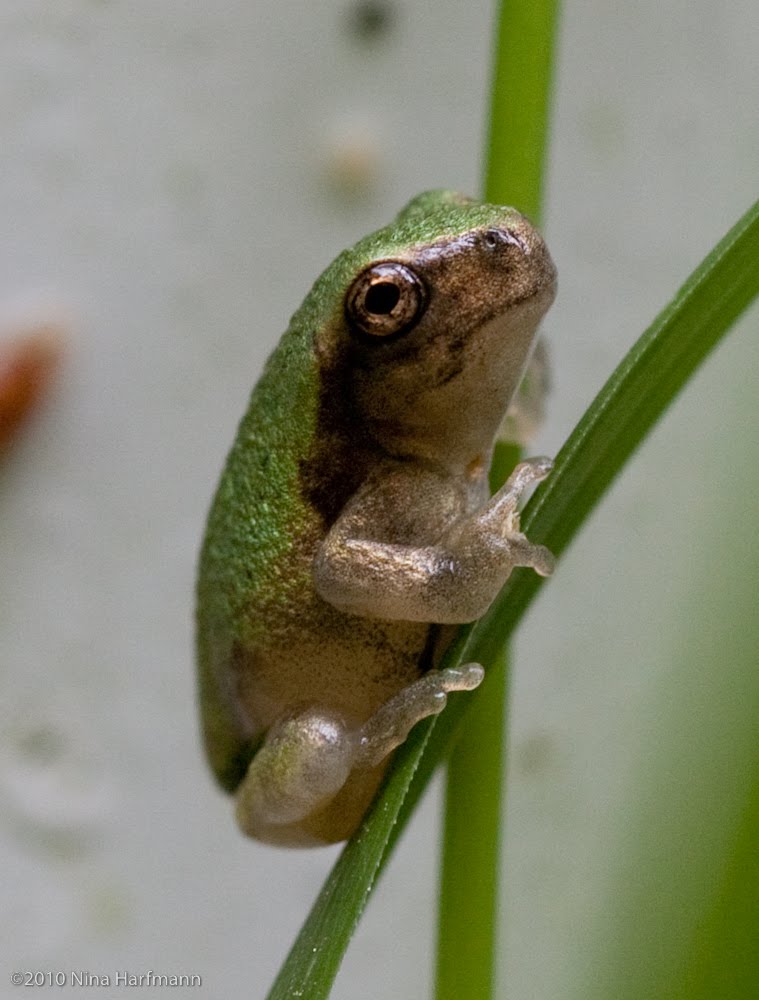
Cope's Gray Tree Frog, froglet on pool

Cope's Gray Tree Frog froglet
Look at those sticky toe pads!

With a pointed posterior where the tail has disappeared,
these tiny froglets are under 1/2 inch long!


Seeking green, he climbs onto a blade of grass.

Toes are so small they're almost transparent!


Little Froglet in the Clover

Although gray tree frogs call throughout the summer, especially on nights when the air is warm (60F+ degrees) and moist, their breeding season is late spring. Ponds, vernal pools and, often, swimming pools are used by tree frogs for breeding. The gray tree frog (tetraploid gray tree frog), Hyla versicolor, and Cope's gray tree frog (diploid gray tree frog), Hyla chrysoscelis, are visually indistinguishable from one another. In parts of their southern geographic range where the 2 species have overlapping distribution, the difference in their calls must be used to tell them apart, with Copes' being shorter and faster.
Tree frogs, in comparison with other frogs, are rather slow-moving and often climb, rather than hop, moving effortlessly along tree branches, well camouflaged by a quickly-changeable skin color. Adults eat crickets, moths and flies.
Can you see the spider, a bold jumper, waiting to tackle a tiny froglet?


Adult Cope's gray tree frogs


Stumble Upon Toolbar

Tuesday, June 7, 2011

We interrupt our regularly scheduled program...

I’ll get back to sharing Michigan’s wonderful adventure soon enough.
But, let’s press pause, set the cool air and fresh breezes aside for a moment, and catch up with a bit of excitement I found in my very own southern Ohio back yard.
After all, what would a sultry summer day be, without tales of long-legged hairy spiders to keep you awake long after darkness has fallen?
You know you won’t sleep soundly anyway. These still, muggy nights can be long, so go ahead…check out these giants of the invertebrate world in my very own version of...
The Spider and the Fly.


My morning walk through the field and past the pond produced just what I had hoped—an offering of food for the guest spider waiting for me at home in a small glass case since being discovered in a corner of the front porch Sunday afternoon. Yesterday’s meal had been quite fine, one large grasshopper, who was quickly snatched and devoured by the hungry arachnid.
This morning, barely a shell remained in the corner of her cage.
The rest had been sucked dry.


Black Horse Fly,
Tabanus atratus


A plump horse fly lazily waking on a stone in the sunshine was an easy mark. It turned slowly to look at me, with broad and dark compound eyes spaced just a bit apart— a female, and with the sturdy prominent mandibles able to inflict a serious bite. Males survive on nectar and lap sweet juices, while the female flies must have a meal of blood before laying their eggs. In a moment I had her wrapped in my hand, headed for home, a hungry spider waiting.


In the summer, you’ll likely find a guest of some sort staying with me.
Caterpillars, praying mantids, frogs, spiders—I learn from watching them more closely, never detain them for more than a couple of days, and turn them loose immediately if they won’t eat. A small glass tank is usually the perfect set-up to keep them safe and sound while I stick my nose in their business. Then they’re turned back to the wild in as close to the place as I found them, no harm done.

Common Fishing Spider,
Dolomedes tenebrosus


The spider was waiting as I knew she would be.
A large common fishing spider, Dolomedes tenebrosus, her dark banded legs could easily cover my palm. Over an inch in length, her body was covered in dense, short, chocolate brown hair.
Eight shiny, black button eyes stared back from within the glass case.

Fishing spiders are members of the family Pisauridae, nursery-web spiders.
Almost as large as wolf spiders (and in the case of mature females, perhaps larger) fishing spiders carry their eggs in a sac until ready to hatch, then construct for the spiderlings a small silken enclosure, in front of which they stand guard. Wolf spider females carry their already hatched young on their backs. What looks at first glance like fur is a writhing mass of legs and bodies--hundreds of tiny spiders!

Rabid Wolf Spider, Rabidosa rabida
with spiderlings on abdomen


The arrangement of the spiders’ eyes is different, as well. While both spiders have eight eyes, those of fishing spiders are divided into just 2 rows of 4 each. Wolf spiders have 3 rows of eyes—3 on the lowest level, 2 large ones in the middle and 2 small ones on top. So, if you ever need a quick and easy ID, look closely at that furry little face!

Common Fishing Spider with prey on tree bark

Named for their ability to take small fish from the water as they stand on the surface, the common fishing spider is actually a tree-dweller, most at home in wooded areas near water and a common hunter by night.

She’d wandered onto the porch from the woods and become quite a visible spider-shaped spot against the white brick of the old farm house.
As I had guessed, this very large spider was quite pleased with what I had scared up for breakfast.
The very large fly, on the other hand, was not at all pleased with the my hospitality.

Common Fishing Spider eating Black Horse Fly


One big spider, one big fly

Stumble Upon Toolbar

Thursday, June 2, 2011

Meeting the Heaths

Wetland in Northern Michigan

Time in Michigan allowed me a chance to meet more of the Heath family.
Nope, not the people...the plants.
These members of Ericaceae, whose species number over 3300 worldwide, are primarily small shrubs, often with leathery or resinous evergreen leaves. And because they dislike limey soils, they’re not likely to be found where I spend most of my time hiking, the till plain of the southwestern Ohio River Basin.
Heaths prefer the cooler temperate regions—the acidic soil of primarily oak woods or the sphagnum mats of (acidic) bogs.

Sedge Wren beside a Wetland

Some are cultivated as ornamentals. You may have rhododendrons or azaleas in your yard. Others are prized for their delectable fruit. Blueberries and cranberries, the flavorful and antioxidant-rich "superfruits," are members of the Heath family, as well.

But I fell in love with bog rosemary and leatherleaf, whose creamy white urn-shaped flowers hung in clusters at the tip or along the stem of fine, scratchy branches beside a wetland in northern Michigan.

Leatherleaf,
Chamaedaphne calyculata


Bog Rosemary,
Andromeda polifolia


Bog Rosemary in flower


Bearberry,
Arctostaphylos uva-ursi


Bearberry in flower


Bearberry in fruit (autumn)

The small, round leaves of Bearberry were dried and smoked as tobacco by Native Americans.


Labrador Tea,
Ledum groenlandicum

Labrador Tea in flower

In the James Bay and Hudson Bay areas, the leaves of Labrador Tea were dried and brewed as tea.


Lowbush Blueberry,
Vaccinium angustifolium


Blueberry in flower


Do you see a family resemblance?

Stumble Upon Toolbar