Monday, August 1, 2011

Heat

Like many others, I’ve been kept off the trail for days by this extreme heat--a wave so wide-ranging and long-lasting that I’m hard-pressed to find a direction to explore, a place escaping the blanket of humidity that, each day by dinnertime, catapults the heat index well above 100 degrees. Waiting out its wrath from within my air-conditioned cocoon, the only exercise I’ve undertaken in these last days has been little more than wading through a backlog of images.

Twig-rush, Cladium mariscoides
(a sedge)

I easily recall an equally warm summer day at Cedar Bog.
Though the comfort index was much greater weeks ago, lacking the humidity of late July, each retreat into the shaded woods from the blazing sun above the boardwalk was a welcome respite. Although the greatest attraction of this fen, for me, would be the sedge meadows, these wet woods hold their own allure in the shadow and light. Tall, straight stands of tulip poplar mingle with a dense growth of white cedar and black ash. Sprawling arms of poison sumac tempt the unknowing for a touch. And the faded forms of spring’s first green, skunk cabbage, now lie lazily on the dark, rich soil.

Can you find the spider in the picture above?

Common Fishing Spider, Dolomedes tenebrosus

Just in front of me, a large fishing spider drops quickly on a long thread and hangs, revolving slowly, at eye level. Well-camouflaged against the backdrop of trees in this dim interior space, her silver cord runs up to a tulip bough and catches what little light passes through the leafy canopy to the boardwalk below.

Seaside Arrowgrass, Triglochin maritima
in the sedge meadow

Bright light ahead indicates the first brief patch of sedge meadow. These open areas, bathed in just several inches of cool, crystalline water, are filled with a tangle of sedges, grasses and forbs and hide one of Cedar Bog’s most beloved summer citizens—the Elfin Skimmer dragonfly. Endangered in Ohio and known in only 3 sites statewide, this smallest of North American dragonflies at less than an inch in length is a tiny relative of the much larger and more common Common Whitetail, often seen cruising the edge of my pond in great numbers for months each summer.

Can you find the tiny dragonfly?

Elfin Skimmers on the other hand, are found only in bogs and fens, and then, in only select isolated communities. Almost impossible to spot at rest, the yellow- and black-striped females are easily overlooked in flight as well, looking more like wasps than dragonflies.

Elfin Skimmer, Nannothemis bella
female above
male below


Kneeling down on the heated boards and scanning the sedge mat, I am finally able to see several bluish elfin males barely clearing the tips of the stems as they flit from post to post, patrolling tiny, invisibly-marked territories one foot from the ground. From this angle, nose to the ground and leaning as far into the meadow as I dare, while still being firmly planted on the boardwalk, I notice that there’s even a pair in a mating wheel!

Elfin Skimmer dragonflies in mating wheel.

They’ll live out their lives right here, as countless visitors walk past--never straying from this sedge meadow, leaving eggs that will hatch into larvae and feed in the very same shallow and cool, clear water of this protected fen.
Most will never even see them.

Grass Pink in the Sedge Meadow

Another shaded section soon empties once more into a sunny sedge meadow. Through the dense stems, spots of brilliant pink peek out from above pools of shallow water. This is Grass Pink, an orchid, whose presence here with the ferns and sedges and grasses, indicates high quality ground water.

Grass Pink, Calopogon tuberosus

More than just another pretty face, this master of deception presents its flower upside down, as compared to other orchids, luring bees to its tempting upper lip, but offering no reward of nectar or pollen. The baffled bee falls backward onto the stigma (reproductive part of the plant) as the attractive upper lip drops down under its weight, and pollen on his back pollinates the flower. With a closer look, you can see how this ploy would work; from a distance, they’re nothing more than pretty spots of pink, barely standing out against a sunny meadow.

Grass Pink, Calopogon tuberosus

A couple emerges from the shaded path in the woods and hurriedly walks past me, continuing their course along the trail. Perhaps they’ve seen this all before—
the rare, tiny dragonflies,
the clever orchids peeking from the grass.
But I would hazard a guess that they have not.
Not for lack of time, nor retreat from the heat, nor lack of knowledge that these things exist—for the bounty of rarities found in Cedar Bog is well-proclaimed.
But for the very reason that tiny dragonflies and clever flowers have in this day become a rarity—
to many, those things just don’t matter... enough.


Stumble Upon Toolbar

Wednesday, July 13, 2011

Another helping of Botany, anyone?

Purple Coneflower, Echinacea purpurea

The Midwest Native Plant Symposium brought together a combination of botanical experts, local native plant vendors and plant/nature enthusiasts for a weekend of wild activities of all sorts. Mornings began with bird walks, just as the sun was making its way onto the sprawling greenscape of Mount Saint John. As anyone with an interest in our birds or bugs soon discovers, they owe their existence to an intimate connection with our native plants as well, which provide that broad base to the food chain, determining and supporting all life above it. Nights wrapped up with moonlit jaunts along the wooded trails or between plots of prairie in search of insects roused as darkness fell--assorted crickets, beetles, moths and katydids. And between those outdoor, exploratory pursuits, a choice of classroom sessions covered everything from Ohio’s champion trees to the tiniest parts of a flower.


A dinner plate scattered with flowers and a hand lens wrapped in its long, black cord waited on each chair in David Brandenburg’s classroom. I had met Dr. Brandenburg before and carry his invaluable guide to wildflowers wherever I go. This morning, we would take a closer look at the Aster family—look more deeply into the largest family of flowering plants, easily recognized by having an inflorescence (flower head) composed of many florets (smaller flowers, each with distinct characteristics). Easily recognized, yes--but perhaps not so easily understood.
There’s a lot going on beyond what the untrained eye can see while watching from the garden’s edge. Breaking open those beautiful flower heads and jumping in with a hand lens is the only way even the experts are able to sort it all out!

Dr. David Brandenburg serves up a plateful of Asters

Some of the most common and well-known flowers belong to the Aster family, Asteraceae (or Compositae)--daisies, dandelions, and thistles—and even to the naked eye, their differences are pretty easy to see. What gives these “flowers” their distinctly recognizable profiles, however, are the tiny florets composing each inflorescence—3 types, which, when arranged in different combinations, create 3 very different looking flower heads.


Beneath the hand lens, the familiar flower parts we all learned in grade school suddenly appear on the face of the daisy. Packed by the hundreds into its center, there are small flowers, each with a tube of 5 united yellow petals and a column of fused anthers. A hair-like style in the center of each emerges and splits into two delicate branches. Each of these minute florets, described as tubular or regular, is called a disc flower and possesses both male and female parts.
But, around the daisy’s white edge, the florets look very different. Strap-like or irregular, these small flowers have 5 united petals, as well, though they projects as a unit only to one side. They are known as ray flowers, which may be female (as in a daisy) or, in some species, neutral, acting only as a flag to attract a pollinator to other non-sterile florets within the flower head. (sunflowers)
Ligulate florets, like disc florets, contain both male and female flower parts, the column of anthers and branched style, but, like ray florets, have fused petals appearing as a single strap.


Combinations of florets create the 3 basic flower heads. The daisy, a radiate head, is made up of a field of disc flowers surrounded by a ring of ray flowers. Thistles are composed of disc flowers entirely and illustrate the discoid head. While dandelions, composed entirely of ligulate flowers, are said to have a ligulate head.


Fen Indian-Plantain, Arnoglossum plantagineum

It's in the Aster family--look closely at the tiny florets making up each 5-part flower! The photo above shows each floret's petals still tightly closed.
Click photos for a closer look!

Now, the fine white petals have curled back to reveal the columns of anthers (those brown things sticking out). Some even show the 2-part styles which have emerged through the columns to tower above them. The orange coloring at the anthers' tips is pollen that is pushed out through the top of the column by the style from below as it lengthens and grows within the column. Cool, huh? And, oh, so tiny!

flowers have passed

So,... what of all these technical terms? Is it simply to sound smart and impress others with a newly-learned, secret language?

Nope, not at all.
Take one peek into any serious plant manual, and you’ll soon understand the importance of getting a grasp on botanical language. With over 22,000 species of asters alone worldwide, subtle differences separate similar species. Keys are written and flowers described with consistent terms to eliminate confusion.
Without concise language, navigating a dichotomous key would be like attempting to follow a roadmap through New York City—one without any street names.
In no time at all, everyone would be lost.

Jim McCormac, our trip leader, quizzes us about the flower heads of asters

The next day, in a trip to Cedar Bog, the classroom language was reinforced in the field. Cedar Bog is far more than a collection of asters, though, with scores of rare or endangered plants at every turn along the 1-mile boardwalk. And, as you’d expect in an area so botanically diverse, we found far more than native plants.

Steve McKee and Cheryl Harner assist from the back

It all starts with the native plants, though.
And our understanding of them and their significance to everything else.


Cheryl Harner and Derek Hennen pause to enjoy the cool breeze from the shade of Northern White Cedars

For contrast, a Michigan Lily, Lilium michiganense--
NOT an aster, no hand lens needed here!


The National Wildlife Federation
Field Guide to Wildflowers of North America
by David M. Brandenburg

Thank you, David, for tweaking this explanation
and straightening out all these florets in my mind!


Stumble Upon Toolbar

Wednesday, July 6, 2011

The Natural Athlete


Excuse me, while I ramble, but being off-task is something I do well--something that, no matter how earnestly I try to walk that straight and narrow path, always takes me on a detour. I eventually find my way back, but not without having pored cover-to-cover over multiple field guides, browsed internet images, and consulted the text, once again. In the end, I am better for my effort. But, the process isn’t linear, by any means. I zig and zag my way through each and every outing. My interest in becoming a better naturalist consumes much of every day.

Roadside Flowers

Determined to focus on birds, I stand at the shoulder of the road, straining to hear a faint song from deep in the woods beyond a field. Atlasing for the Ohio Breeding Bird Atlas (OBBAII) is training my mind to listen better to what it is likely that I have heard all along, to separate from the chorus of song each individual voice, to think in advance of what might be chipping, unseen, within each fence row. It’s less an exercise for the ears, more an exercise in figure-ground—and with each day, a bit more of my initial difficulty eases. I hear the subtle sounds, and gradually learn to put names to them.

Beyond the white board fence at the roadside, my neighbor’s horses graze in the distance, shielded from the midday sun by the broad arms of four large maples lining the gravel drive. This pasture rings with the song of Eastern Meadowlarks each morning. Barred Owls call from the dimness of the woods behind it by afternoon. And I know a pair of Louisiana Waterthrushes has tucked a nest where I will never find it. Last week, I caught a glimpse of them up the road as they bobbed their way along the creek bed and disappeared in this direction.

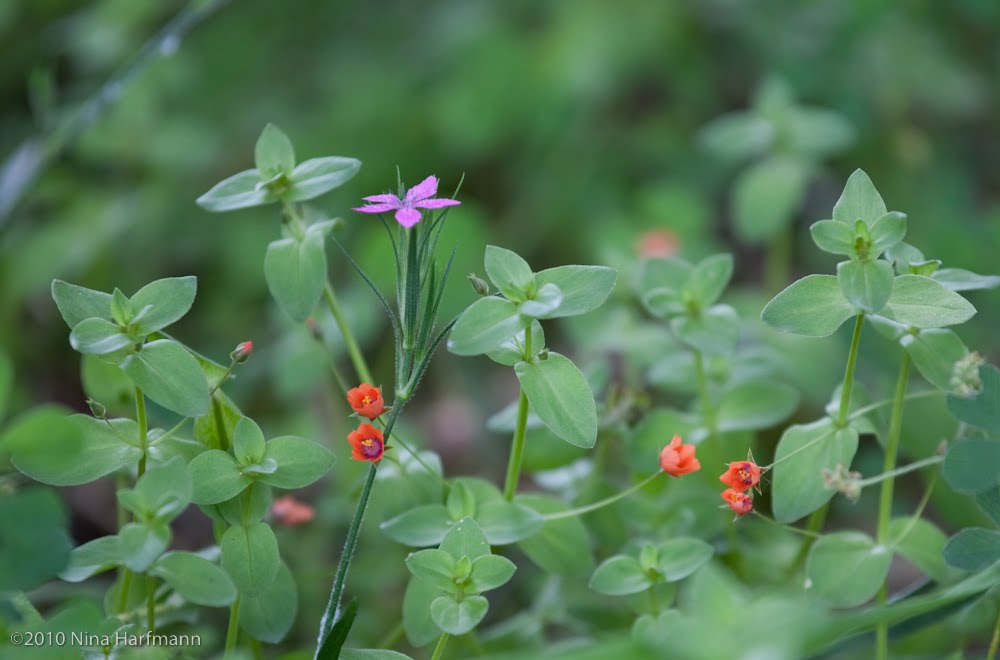
Scarlet Pimpernel, Anagallis arvensis

Beneath the fence, a small fleck of red peeks out of the weedy road’s edge in front of my toes. Scarlet Pimpernel? Its fleeting flowers fully open, and I without my camera! I know it’s not native. Yet, I’ve seen it only once before, and never on this path I walk. From birds, I turn and think of flowers. Flowers are what I am studying at home.

Books have become my weight-training—a repetitive task whose benefit isn’t fully recognized until tested. Weeks ago it was books about warblers. In the heat of summer, I’ve switched from books about birds, to books full of plants and insects. And the test, is my daily walk, which at times, with the pace of change, seems like a race I will never finish. I think of others in the race before me, those more-skilled naturalists running circles while I still purposely plant each foot, those able to lithely name each plant, each bird, each frog, each butterfly. Not competitors, fellow-athletes, who by closely following whenever I’m able, catapult me yards ahead with an afternoon of birding or botanizing. Just a few strides ahead of me, are others, too, their place within my reach. Many jog by my side.

I read about Scarlet Pimpernel, Anagallis arvensis, and learn it is a member of the Primrose family and a Eurasian native, but 4 pages ahead of its description in my manual is Bird’s-Eye Primrose, Primula mistassinica, a native with the diminutive pale pink petals I saw early this summer on the gravelly Michigan shore. I find Whorled Loosestrife listed here too, Lysimachia quadrifolia, that I saw on the prairies of Adams County weeks ago.
With photos gathered, the text begins to come alive.
I study the Primrose family.

Bird's-Eye Primrose, Primula Mistassinica

Bird's-Eye Primrose, Primula mistassinica


Whorled Loosestrife, Lysimachia quadrifolia


Scarlet Pimpernel, Anagallis arvensis

But with a little knowledge gathered, the quest begins again. What about those other loosestrifes that are in a different family? I know I saw one bloom last year, along this country road. Was it Purple Loosestrife, the much-hated invasive, or Winged Loosestrife, the native species, still purple, but with the single flowers? Can I catch it flowering before the township cuts it back?

The afternoon sun is blazing as I walk the country block to the place I knew that I had seen it. Bikes fly past me, bikers drenched in the sweat of their workout. But I move with a different purpose—putting names to as much as I am able as I walk steadily down the path…birds, plants, and more. Here, on a straight lane that runs between 2 soy fields, the shoulder is blanketed with clover. Zebra swallowtails drink in its nectar while Sulphurs and Eastern-Tailed Blues tumble between them. Only the quick-to-recover chicory stands taller than the shorn weeds of the roadside. But it is enough to provide perches for several Halloween Pennant dragonflies.
Tonight I will read about insects—prepare the natural athlete for the next race.

Halloween Pennant dragonfly


Halloween Pennant in obelisk

Stumble Upon Toolbar

Sunday, July 3, 2011

Have you seen...


The face beyond the windowpane,
drawn to the light from within,
bumps noisily head to glass,

as I, on the other side,

peer carefully nose to glass,

drawn to the darkness of this night,

and look out to see who’s knocking.


This is a Reddish-Brown Stag Beetle, Lucanus capreolus, and his fearsome appearance at your window on a balmy summer night might cause you to wonder what his intentions are.
Who’s he after with those long, elbowed antennae and over-sized mandibles?
He looks quite the brute.

Reddish-Brown Stag Beetle, Lucanus capreolus

Truth be known, although some members of the insect world are voracious predators, feeding like a wheel bug that sucks the juices from its hapless victim after injecting it with a powerful jab, stag beetles play more the role of decomposer. After hatching from an egg, the larval form, a fat, white grub, lives for 2 years in fallen logs turning decaying wood back into rich, dark soil, then over-winters as a pupa. In their adult form, although those mandibles could pinch defensively, stag beetles simply feed on the sap from trees, using the smaller finger-like appendages (palpi) to move food toward the mouth. His large jaws, resembling the antlers of a stag and in this case indicating that he is a male, are used against other males as they spar, much as do male deer, for the rights to a female. Any confrontation from a curious finger, and he will rear up and hold those awesome pincers proudly forward in defense.


Coleoptera, the order within the class of insects to which beetles belong, are so named by the combination of 2 Greek roots meaning “sheath-wing.” While some insects like butterflies or bees have 2 pairs of visible wings, the forewings of beetles are hardened and cover the softer second set of wings folded beneath them.


He’s perfectly suited for climbing, as well. Just look at those grapelling hooks at the end of his barbed legs.


Antennae with comb-like clubs scan the night air in his search for a female. Listen late at night as he taps against the glass. He’s just going about the business of beetles--he means you no harm.


"Have you seen...." is an effort to discover the unusual beauty in things not usually appreciated for their beauty.

Stumble Upon Toolbar

Wednesday, June 29, 2011

A snake in the grass... and some flowers along the way


A summer walk down a grassy path will quickly tell you one thing—there’s far more here than meets the eye. From beneath the tangle of green, field crickets sing, unseen in the heat of the day. Grasshoppers, startled from their hiding spots, lift suddenly with a golden flutter like small birds to a new resting spot, feet beyond my steps. With the rattle of freshly dried wings, a dragonfly frees herself from the thickness of tall stems and takes to the air. And a tiny toad, barely the size of my toenail, tucks himself silently into the safety of the uncut roadside.
I think about what I cannot see—for the most part, so as not to miss something I might find interesting. But also, for my safety, as well.
There might be venomous snakes.

American-Ipecac,
Gillenia stipulata


In my county in southwestern Ohio, I walk without concern. But traveling a few counties to the north or a few counties to the east quickly puts me in different territory.
In wetlands, I wonder…Massassauga rattlesnakes?
In the unglaciated hill country, I think…timber rattlesnakes?
And, when the dirt beneath my feet turns from beige to blushing brown, I know to beware…copperheads.

I’ve never seen one in the wild.
I’ve always hoped to discover one, though—watch it carefully from a distance as it warms itself in the afternoon sun or slithers across the path a few feet ahead of my footsteps. As long as we both see each other and give each other space, I really don’t worry about encountering snakes. It’s just the thinking about what I cannot see that reminds me to be ever vigilant and keeps me safely walking on the mowed paths when I travel.

Downy Wood-Mint,
Blephilia ciliata


The prairies of Adams County have held a special allure for me this spring.
In the past weeks, I’ve walked there 5 times—on different paths, each vastly changed as the season has progressed.

Narrow-Leaf Mountain-Mint,
Pycnanthemum tenuifolium

With each trip east, as the clay gives way to sand, as the farm fields roll up and over hillsides and rain-carved furrows in the pastures reveal the rusty soil, I’ve watched summer unfold a prairie landscape so rare that it feels like I’ve walked back...into a time before Ohio saw settlement.

Prairie-Dock,
Silphium terebinthinaceum


Tall prairie grasses and the broad leaves of prairie-dock fill the small opening in the surrounding woods of post and blackjack oak. The ground is gritty and dry. Of prairie types, this is described as “xeric limestone” and its southern exposure and hilly terrain offer little water or shelter from the afternoon sun.

Prairie-Bluets,
Stenaria nigricans


The plants that grow here are tough as nails.
With long taproots and leathery leaves, they grab and hang onto each precious drop of water, endure drought and fire, resist everything--except the plow.

Pale-Spike Lobelia,
Lobelia spicata


Eying a tall, slender spike of tiny, faintly blue flowers, I stepped carefully one foot off the trail and focused my camera. Caught in my peripheral vision, a flattened, coiled object the size of a dinner plate lay motionless in the grass a few feet away. I glanced quickly down and froze in my tracks, the orange scales at my feet making my heart pound, my camera drop lazily around my neck.


More aware of my intrusion than I had been of her presence, she eyed me as well and flicked her black-tipped tongue without flinching--a large garter snake warming herself in the safety of the tall prairie grass. But in my head, she had become the copperhead I knew was also hiding there.
Lesson learned: pictures from the path, snakes in the grass.


The Eastern Garter Snake, Thamnophis sirtalis, is one of 3 species of garter snakes found in Ohio. Usually between 18-26 inches in length, this individual was close to 32 inches—still a bit less than the outer range of 48, but the largest garter snake I’ve ever seen!
Usually marked by 3 light-colored stripes, one dorsal and 2 laterals covering rows 2 & 3 on each side, eastern garter snakes have varying colors (blues, browns, greens) and patterns (stripes, checkerboards). Most active during the day (diurnal), they are frequently found basking among vegetation or in low shrubs. Although they tend not to climb, they are good swimmers and may be prefer sites close to water.
Because of having an adaptable diet, garter snakes are found in a variety of habitats and although always carnivorous, may eat worms, frogs and toads, mice, bird eggs and even carrion. Because they are not constrictors and do not have venom, garter snakes rely on powerful jaws to overpower prey. It is thought that a mild toxin in their saliva may subdue frogs and toads until swallowed.
Garter snakes have live birth (ovoviviparous) but give no care to their young.
Though not aggressive, if approached, they will coil and strike and are known to vigorously defend themselves by biting and musking.

Lance-Leaf Bedstraw,
Galium lanceolatum


Stumble Upon Toolbar