Tuesday, November 24, 2009

A Day with the Cranes

Paired for Life

From behind us, a rosy sun emerged above the stand of pines, glowing warmly on our backs and upon the breasts of the gathering birds, casting their gray feathers countless shades from icy white to slate blue, and lavender to silver. Growing steadily in size as more arrived from their overnight roosts in the marsh, the massing in the field stood around a shallow puddle, facing the warming rays, their red foreheads ablaze. Across the brightening sky, the stars stepped back and hundreds of tiny, dark specks became the long chains of the noisy birds, drawn to gather here each morning, and whose distant rattling calls began to fill the quiet of a cold, November dawn.


Ritual of the Dance

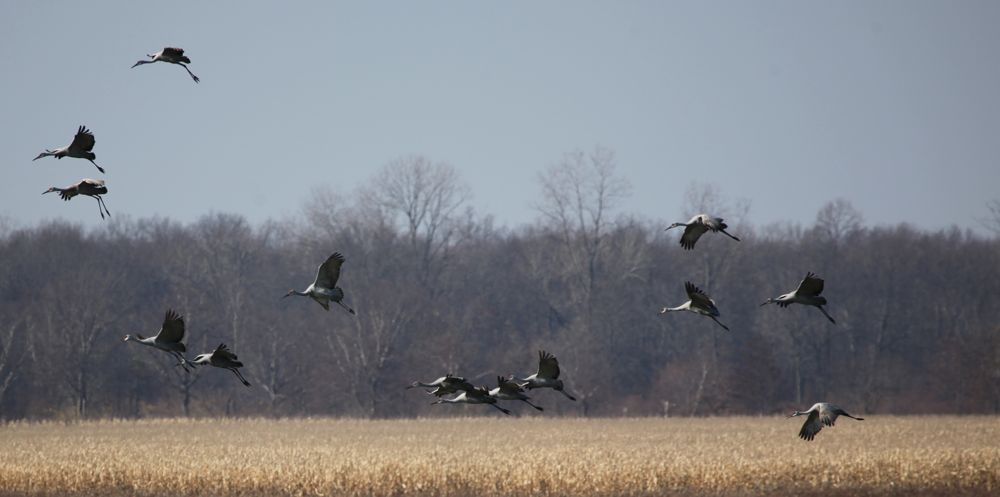
Those already on the ground danced and displayed, calling to their partners, standing with their young. While hundreds more dropped from the sky, joining the assembly from every direction. Out of perfectly synchronized spirals above the field, large groups turning as one, banking their 6-8 foot wingspans, landed--small parachutists floating gracefully to the grass. Then, they too, danced with their mate, this partner paired for life and tireless traveling companion. Barely heard between their constant calls, as the thousands of cranes filled Goose Pasture, was the airy whistle of the juvenile birds, this flight, their first of many.

The Arrival of One Hundred


Goose Pasture,
Jasper-Pulaski Fish and Wildlife Area

For several hours, birds continued to arrive--in pairs, small family groups and even great strings. Then forming large flocks facing the sun and with a few effortless steps, they took noisily to the air, flying low and calling out above the tower. We watched them leave for the surrounding fields, their necks stretched forward and black legs trailing, red foreheads brilliant in mid-morning sun, dancers' toes pointed, nails curled. They did not seem to mind the flurry of camera shutters, as all locked onto their steady orange eyes, and wide wings took them from view.

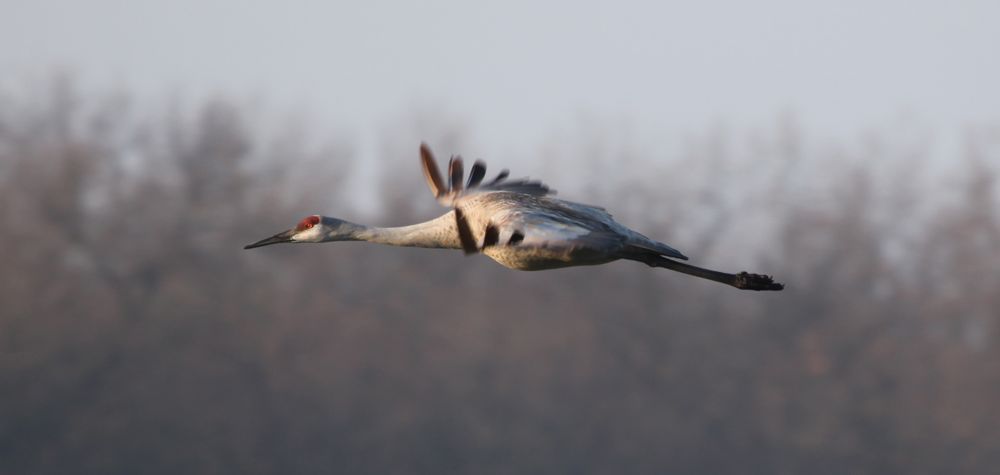
Greater Sandhill Crane, Grus canadensis, in flight


Flying off to the fields to feed

Later that day, we drove the nearby roads and easily spotted groups of them, standing in contrast to the dark, fertile soil, gleaning spilled corn from the expansive harvested fields, miles beyond Goose Pasture. Great flocks soared overhead reaching extreme heights, riding thermals, wing-to-wing as afternoon skies turned to blue.

To Soar


Those that remained in the pasture for the day lined the grassy edge of the narrow drainage ditch--stepping in for a great, splashy bath; stepping out and preening in the warm, mid-day sun. With their long, dark bills, they probed the tender ground, raked the tall grass snagging small tidbits--earthworms, insects, and a small mouse-like mammal, which, with its discovery, became the object of much envy. Cranes beside the shallow puddle dozed in a one-legged stance, head tucked behind a wing. An occasional flutter would erupt from the otherwise calm crowd, and the pairs of cranes danced once again, bowing and raising their bills.


Caring for those lovely feathers


"Whatcha find, a shrew?"

Adult and juvenile cranes

Two pairs dancing


Looking out across Goose Pasture and the thousands of cranes gathered there that afternoon, each one just a part of this great migration, I could not help but think back to my first crane sighting, just months before, while we traveled through northern Michigan.
How we struggled to find just the few, and reveled in catching a distant glimpse as they hurried out of sight, and hid themselves deep within the refuge.
How their hollow, rattled call in that vast, empty wilderness carried an almost melancholy air.

More than merely time between two places, I have come to understand that it is this great gathering together in migration that defines the Sandhill Crane.

Please continue to follow this story here.

Stumble Upon Toolbar

Monday, November 23, 2009

Sunrise of the Sandhill Crane

Sunrise
Jasper-Pulaski Fish & Wildlife Area
Medaryville, Indiana

We drove alone in the dark, down the straight, narrow roads of a small, rural community in northern Indiana, its massive fields of shortly cropped corn still covered in wisps of early morning fog. Aside from small blinking lights on distant towers and a scattering of stars above, the clear sky in total black on this day in late November had let every bit of yesterday’s warm afternoon escape.
Fueled with anticipation, I almost did not feel the cold.

Sandhill Cranes in predawn sky

It was a race to be the first—to arrive at this site before dawn and watch the gathering of the sandhill cranes. From their nighttime roosts in the nearby marshes, each morning at sunrise thousands of the large, migratory birds assemble in Goose Pasture of Jasper-Pulaski Fish and Wildlife Area, and then fly off to feed for the day in the harvested fields before returning to the pasture at sunset, and flying off again to the marsh.

The lot was empty as we pulled in.
Beyond a row of pines, I could see the grassy field and the shadowy form of the tall, wooden deck overlooking it, its weathered platform and long rails waiting for the day’s crowds to arrive. At the peak of the cranes’ 3 to 4 week stopover along this route of their southern migration, numbers can reach between 15,ooo and 30,000 birds. Predictably, birdwatchers arrive by the busload.
Dimming our lights and silently pressing the car doors closed, we assembled ourselves in the dark—jackets, hats, and mittens—and made our way quietly down the paved trail to the observation tower. A light covering of frost had been left on each stair, and in the predawn light I clung to the safety of the rail, feeling my way along, climbing carefully to the top.

Goose Pasture

As far as I could see, the pasture was still empty.
Fog hung in the low areas, curling around the bases of trees where the field met the woods in the distance. A small drainage ditch trimmed in tall grasses and filled with the white mist ran at an angle toward the back and broke the space into two sections, one, uncut and tangled brown; the other in front, short and green. Behind me, the starlit sky hinted of a pink dawn. A distant farmhouse sat quietly by, with windows softly glowing.
And from deep within the safe and grassy space, day began with the voice of a single sandhill crane.

return of the cranes at sunrise


(all photos click to enlarge)


Greater Sandhill Crane, Grus canadensis

Please continue to follow this story here.

Stumble Upon Toolbar

Thursday, November 19, 2009

The Hungry Lake

Twelve-mile Beach,
Lake Superior

Waves tugging at the sand beside the broad blue of Superior, with great effort she lifted herself-- each labored step, dragging her clumsy body a bit further, beyond their reach onto the otherwise empty, windblown edge of Michigan’s Twelve-mile Beach.
Knocked off the breeze carrying her in carefree flight above its lapping waters by a long, curling tongue of this hungry lake, she’d escaped a watery death.
But, wings now heavy with droplets, she could not rise from the smooth, wet sand.

Green Darner dragonfly, female

As the grains dissolved from beneath each tiny, clawed foot, I stooped and lifted her onto my finger and walked with her, while the wind dried her transparent wings.
I left her to rest on a strand of beach grass beside the great lake, which boasts of many victories--having devoured so many, so great.
While her insatiable hunger goes on, I stole this dragonfly from her plate.


windswept sand


(click to enlarge)


Twelve-mile Beach


See more Skywatch here.

Stumble Upon Toolbar

Tuesday, November 17, 2009

In Hiawatha's Footsteps

Tahquamenon Falls, Michigan

the Upper Falls from the platform


The Tahquamenon River (rhymes with phenomenon) flows north into Lake Superior, after winding nearly 100 miles through Michigan’s Upper Peninsula to empty into Whitefish Bay. From swamps lined with hemlock and spruce, their tannins having stained its rushing waters brown, it passes here, over the Upper Falls in Tahquamenon State Park, falling 50 feet from a magnificent rocky bed, 200 feet across.
A viewing platform holds visitors from the edge and steers them along a partially paved, intermittently boarded walkway, scattered with signs and heavily treed with birch and dense evergreen.
Years ago, the Ojibwa walked these woods—traveling this river in their birch bark canoes, hunting these woods from its shore.

the Lower Falls,
Tahquamenon State Park


We stepped from the boardwalk, leaving the hollow footsteps of galloping children at the river’s edge, and entered the dark and quiet woods. A narrow, marked trail crossed a small feeder stream then climbed up a hill where patches of sunlight fed an assortment of ferns on its bank, and heavy moss grew soft on fallen logs beneath their shadow. Though still September, already the leaves of poplar and birch were fading and fallen—the winding trail, no more than an earthen path between them. And our footsteps, barely heard.


From behind a small hemlock, scurrying steps suddenly stopped. And we peeked beneath its lowest branch to see three dark birds, just off the trail, several feet in front of us. Not rising in the flurry of flapping wings as I would have expected, the small group of Ruffed Grouse barely moved, disappearing in their stillness against the shaded leaves. And as I sat squarely on the dirt, inching forward with my camera, they stayed, perched on the low branches, peeking back at me. Then in no hurry, stepped off and crossed to the other side of the trail, following the hillside past the patches of sunlit fern.
Here, on a quiet trail in the land of Tahquamenaw, it was as it could have been, in years past.
As if I walked in Hiawatha's footsteps.


Ruffed Grouse

From an assortment of sources, I have learned that Henry Wadsworth Longfellow’s poem, The Song of Hiawatha, which was written based upon legends of the Ojibwa and other Native American peoples, refers to “the rushing Tahquamenaw,” a spelling variation coming from an Ojibwa word meaning “dark berry.”
Written in several forms, some dating back to Jesuit maps published in 1672, this word has varied in spelling from Outa koua minan to Otikwaminang, Outakwamenon, Tanguamanon, Toumequellen and Tahquamenaw.
From Wikipedia:
"The current name for the Tahquamenon River in the Ojibwa language is Adikamegong-ziibi, "River at where the Whitefish are found." This name is also the naming basis for the Whitefish Point and Whitefish Bay, both known earlier as Tahquamenaw."


Tansy

Pearly Everlasting


View more ABC Wednesdays here!

Stumble Upon Toolbar