Saturday, September 11, 2010

What floats my boat

I love nothing better than to push off from the shore of a broad, shallow lake and float out into its center--
the entire body of water around me, quiet and still.
Sitting low to its surface in my kayak, the sky above it all seems even more huge, its open space a giant dome across which birds and dragonflies course—
while I drift as a lone, small speck below.

Bald Eagle above Salt Fork Lake

Onto the quiet water in a small arm of Salt Fork Lake, a reservoir encompassing nearly 3,000 acres of water within Ohio’s largest state park, I floated with 2 friends in 3 small crafts—
Julie's 2 canoes and my kayak.

T.R. and Julie on the Lake

Fanning out from this hidden shore, we spread across the water, the entire space in this small corner ours alone.
Each carving a distinct path,
each finding his own perfect treasures to explore,


we paddled beneath the wide, arcing flight of a young eagle.

And were held in orbit around a tiny spot of color as she rested on the darkened remains of a flooded tree stump, now a pint-sized island sprouting elfin versions of the earthbound greenery along the shore.


Julie & ?

Question Mark butterfly on submerged stump

T.R. & ?

Bit by bit, we’d drift apart, pirouetting across the water to look into the face of a dancing fox hidden in weathered wood,


exchange a smile for a hand-delivered sandwich,


or paddle buoyantly--
because the freedom of water and waves feels like nothing else.


Then fall into line and speed to the opposite shore as one up ahead spotted a distant object standing motionless in the shallow water—


and knew all three would want to see.


Great Egret

As we watched the great white bird, a light rain fell across the glassy surface, and we sat in silence--
alone with the lake, but not.


My paddling companions:

Julie Zickefoose, author of Julie Zickefoose on Blogspot, writer, naturalist, NPR commentator, watercolor painter, gardener, packer of wonderful lunches, Mether to Chet Baker, fellow Ohioan,...friend,


and T.R. Ryan, author of From the Faraway, Nearby, photographer extraordinaire, talented journalist and writer, world traveler, conservationist, Oklahoman,...friend.


Stumble Upon Toolbar

Wednesday, August 25, 2010

The road to a friend's house


From the southwestern corner of the state, I drive east, along a highway laid straight between planted farm fields all around. Flat and sprawling acre upon acre, they are green now with corn and beans or stand bare while the glossy stubble of harvested wheat fades to gray beneath the bleaching rays of the sun.

Mile upon mile, as distant clusters of barns and sheds tucked neatly between the broad expanses slowly disappear from view, a heavy flow of traffic travels this long straight path—a racing river of cars and trucks linking Ohio’s largest cities. Until on the horizon, from behind a row of trees, the hint of eastern hill country first appears in rolling pastures, steep slopes bathed in the amber glow of a summer evening, the steeple of a small white church that rests amid a stand of pines stepping down the ridge.

One after another, fellow travelers exit the highway. Four lanes have dropped to 3 and before long, shrink to 2. Aside from the few cars that trail behind, the road is mine now as it rises and falls along its heavily treed course toward the Ohio River.


From here I will take a smaller road that winds and dips, plunging into the hollows and returning to ride the ridge. Then meet the worn gravel road flanked by hay fields, sweeping a wide arc beside the uncut grassy meadow.


Because the road to a friend's house is never long.


Surrounded by a wildness that with each season brings new beauty—
by woods adorned with spring’s first wildflowers,
a meadow ripe with summer song,

katydid in grass

smooth sumac, Rhus glabra
in flower

flowering spurge, Euphorbia corollata


she surrounds herself with flowers that tell of her great spirit--

keeper of the innocent,

one who is gentle and kind,

one who is bright and warm.
(and smart and funny and strong...)

No, the road to this dear friend's house could never be too long.


Julie Zickefoose

.

Stumble Upon Toolbar

Friday, August 20, 2010

Robber Fly

Robber Fly with Kill

There’s a thief among us--
a predator who snatches one, then another, from her lookout on the rusty rail of the field fencing in my overgrown pasture.


She takes to the air and effortlessly grabs hapless insects in mid-flight, wrapping her spiny legs and clawed feet around some larger than herself, while some are smaller and easier prey.

Robber Fly with small wasp or ant

With little chance of escape, they’re instantly immobilized by a dose of neurotoxic and proteolytic enzymes deftly delivered through the tip her dagger-like proboscis.
Within minutes, she’s drinking them down.
Robbed of the life within, an empty shell falls to the ground.

Robber Fly preying upon Common Whitetail Dragonfly

Robber flies are skilled predators of the insect world and, though usually of no harm to humans, able to inflict a painful stab if handled carelessly. Many genera and species exist worldwide, some fairly small and some rivaling bumblebees and dragonflies in size.
This particular individual may be of the genus Promachus or Proctacanthus, both large and aggressive, bearded robbers.


There are many dragonflies left in my field.


Common Whitetail dragonflies
2 males (above) and female (below)

Stumble Upon Toolbar

Tuesday, August 17, 2010

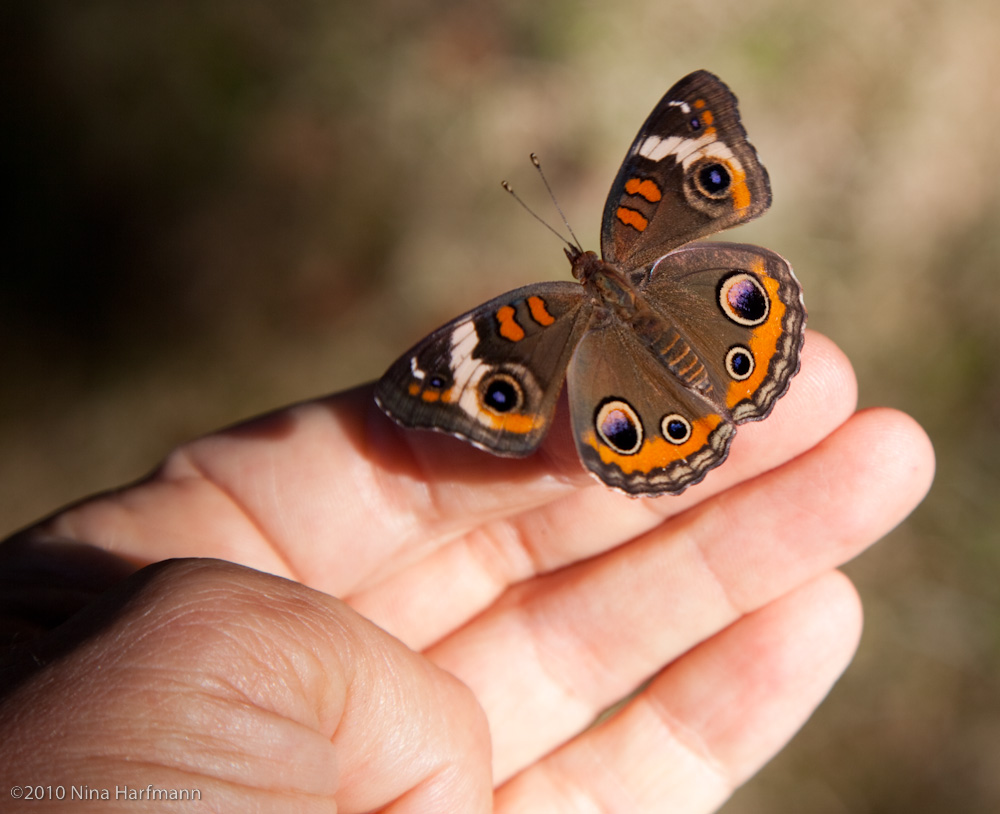
Beautiful Buckeye

Common Buckeye, Junonia coenia

There is a gentle flutter against the glass. On this cool morning, each of a handful of butterflies begins its life upon wings and waits to fly in the first warming rays of the sun.
They’re my beautiful Buckeyes—found as caterpillars just several days before, as I walked the mowed path ringing a summer field filled with riotous wildflowers.
Absorbed in a torrent of insect song brought on by that steamy morning, I had walked into their midst, barely noticing their wanderings below on a patch of path 6 feet wide and stretching 15 feet down the trail. Their colorful but dark, softly-spined wormy bodies fed furiously at my feet on the short stems of plantain interspersed with cut grass.

Common Buckeye caterpillar on plantain

Tiptoeing between them and picking up one after another, I soon had a handful of brilliant wriggling worms reluctant to remain in my cupped hands while I hurriedly headed for home. Basically a solitary caterpillar, this spot of lawn had apparently been chosen again and again by an egg-laying adult, as she flitted from one food plant to the next—a single green egg left each time. And scattered densely along my daily walkway, I was sure this caterpillar nursery would meet with an unfortunate end.

Common Buckeye caterpillar on Ruellia

Safely tucked into my glass tank enclosure and stuffed with fresh sprigs of Ruellia and assorted plantains, days later 31 cryptic chrysalides hung from silken tethers around its lid.


Not yet warmed enough to take to the air, each turns, open-winged to sit in a spot of sunshine, then lifts from my finger and floats across the field.


Stumble Upon Toolbar

Friday, August 6, 2010

Have you seen...

Garden Sunrise

A vine has covered my garden in the way that daylight creeps across the yard—
from the first tender rays in one corner, stretching and fanning out until only a few spots remain untouched, those safely hidden behind another.
If it were any other, I would pull it—yank its long reaching arms and winding fingers from my vegetable patch, where a few withering pumpkin plants struggle beneath the heat of an early August afternoon.
But it is milkweed.
Sand Vine.

Sand Vine, Cynanchum laeve
the other milkweed

This climbing milkweed, Cynanchum laeve, with its heart-shaped leaves trimmed pink at the stem and clusters of delicate white flowers spaced along its length feeds more Monarchs than the tough and leathery common milkweed standing just feet away in my field.

Sand Vine blossom


Sand Vine seed pods


In the first light of day, striped caterpillars cover it, coursing its twisted stems, cruising the pathway from one tender leaf to the next. Until, sated, they hang as chrysalides—luminous green charms across this heavy milkweed blanket.

Monarch caterpillar feeding on Sand Vine

Their appreciation is boldy stated—
orange wings cover my field.

Monarch nectaring on ironweed


"Have you seen...." is an effort to discover the unusual beauty in things not usually appreciated for their beauty.

Stumble Upon Toolbar

Thursday, July 29, 2010

Butterfly Gardening

Black Swallowtail caterpillar on dill with dew


Black Swallowtail caterpillar,
Papilio polyxenes

I deftly plucked one from the stem—
a plump striped caterpillar who was making a meal of the feathery fingers of dill at the edge of our vegetable garden. And, pleased with my find, paused just long enough to snap off several stems of Queen Anne’s lace before running inside with my prize.

Setting up a small bud vase in the center of the table, I transferred her gently to Queen Anne and sat down to refresh myself from the heat of the afternoon.
Two summers ago, I had set up a vase in just the same way. Having found a caterpillar that I recognized to be of a Black Swallowtail, I watched her grow as she contentedly grazed for days amid a small bouquet of wildflowers, became a chrysalis and emerged into the freedom of an early August morning--the constant shower of frass, the only downside to hosting this unusual dinner guest.

And so I thought it would be with this one.
Yet, within the first several minutes, she dropped to the table, made a hasty trail to the edge, and tumbled off into my waiting hand below. Replacing her again and again, I watched as she repeatedly dropped and nimbly raced each time to the same edge.

My invitation to stay a while apparently not to her liking, I took her back to the dill in the garden, quite sure that by morning her walkabout would have taken her far away.
Instead, I found her tethered to the spot from which I had first picked.
Now a butterfly grows in my garden.


Tethered to a stem with silken strands


Dill

This year, Black swallowtail caterpillars, whose foodplants are parsley, fennel, carrot and other umbelliferae, have chosen to devour the dill in my garden. Commonly cultivated dill, Anethum graveolens, has bluish-green fern-like leaves and compound umbels of tiny, bright yellow flowers.
In the days between hatching from a single small yellow egg and forming a chrysalis from which will emerge a lovely swallowtail, these eating machines shed their skin several times as they grow through 5 instars (developmental stages between molts). This small and spiny dark caterpillar with the white saddle (photo below) is an early instar and barely resembles the later black and yellow speckled instars.

early instar on dill

Stumble Upon Toolbar