Rural Ohio in January
It was cold.
From where I sat, impatiently idling in the deserted intersection beneath a single swaying red light, I looked across to an illuminated bank sign at the corner of Rt. 36 that confirmed it—1:42 p.m., 13 degrees.
Although I was heavily dressed in layers of fleece and tightly tucked into my warmest of woolen socks, my toes still held the chill they had gotten in my brief walk to the car, though its heater had been sending a steady blast of warm air past them for the last 2 hours.
Crossing Ohio just to the north of Dayton, driving east along the wind-buffeted route that took me past sprawling farms, their wide fields white and quiet, I would soon arrive at Big Island Wildlife Area, 35 miles to the north of Columbus. For the most part, the travel was easy. Only as the clusters of homes and small villages stretched further and further apart to become barren flatland, did drifts and icing-over become a concern.
Already, everything about this place, everything about this day made it a perfect one for winter birding.
Months before, this drive would have been a very different one. In May or June, I might have seen an oriole or a tanager flitting through the branches of a big, old tree in town, indigo buntings singing from the top of the tallest corn stalk beside the road, woodcocks displaying in the evening light above the grassy fields. Missing them and many others who have flown south to warmer climes, I forget that in their place, others have arrived for just a brief stay.
For those to our north, this is the south.
And a winter’s day can show them at their finest.
 Field in Snow
The sunshine of the morning blew past. Left in its place was a dark sky that dropped swirls of snow dancing onto the shoulder of the road before spilling over and filling the ditch. I turned carefully from the highway onto a gravel county road, where several cars had passed ahead of me leaving just 2 narrow tracks to follow. Over the field beside me, a northern harrier floated low, tipping and turning, looking and listening for small prey scurrying just feet beneath him in the grass. This expanse at Big Island, a combination of wet prairie, grassland and cropland, is the perfect habitat for both the small rodents and the predators like this hawk whose diets they compose. The harrier continued his course, scouring the tall grasses for mice and meadow voles. On the opposite side of the road, a northern shrike watched for the same from a perch on the tip of a small brushy tree.
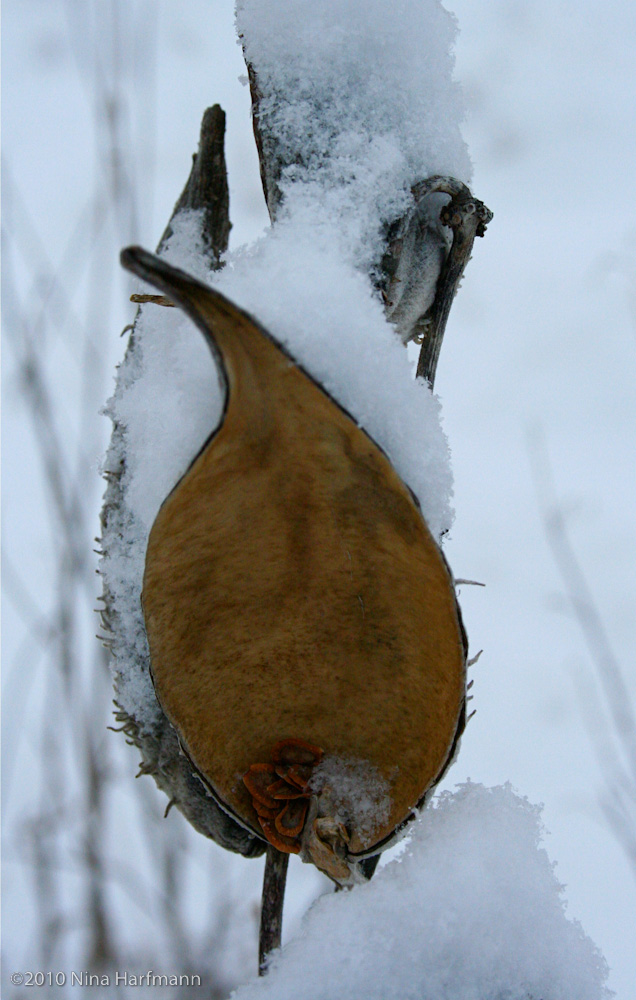
 Milkweed Pod in Snow
I parked the car and walked back through the grassy field toward the tree line, staying within the shelter of one of the dikes containing a small pond. The wind had picked up its pace. Flurries filled the air until the trees ahead of me almost disappeared into the whiteout. My fingers ached within the heavy gloves and my eyes teared with the sting of the cold wind, fogging my binoculars as soon as I brought them to my face. Something was flying in the distance though, with long flappy wings that showed white from below, and a head short and dark. It was an owl.
 Short-eared Owl, Asio flammeus
Short-eared owls, similar in size to barn owls, breed to the north in Canada and Alaska and winter in open grasslands to the south where milder temperatures and abundant rodent populations provide a steady food supply. Unlike other owls,
Asio flammeus, Latin for flaming or the color of fire, rests on the ground, roosting in trees only when snow cover is extreme. Hidden within the tall stems of golden grasses or standing still in a field of cut corn dusted with white snow, their buffy breasts and tawny tones make them almost invisible.
 Grass in Snow
In the distance, the owl had dropped down. His keen eyes and acute hearing so vital to his skill as a hunter would mean I could not approach without his first seeing me and flying off. There is no sneaking up on an owl.
 Short-eared Owl at Sunset
Just beyond the grassy field, as the afternoon sun re-emerged from the snow clouds for the last moment of warmth before evening, 5 birds lifted from a cornfield and circled overhead as I sat nearby on the snow. Catching the light on their richly brown backs, broad, round faces glowing in the fleeting light of evening, they turned again and again, flying above me for the last minutes of the day, then settled hidden again into the grassy field.
The ride home seemed somewhat warmer, though in passing the bank, the sign still registered only 13 degrees.
Perhaps it was winter's cold that was slowly lifting.
Or maybe it was the afterglow of watching the flaming owl.
The short-eared owls of Big Island Wildlife Area


 Winter Wrap-up
 Northern cardinal, male
 mourning dove in winter
 purple finch, female
 purple finch, male
 white-throated sparrow
 Spot o' Sun
 white-tailed deer









%20copy.jpg)