Saturday, April 16, 2011

Little men of the spring woods

Dutchman's Breeches

I climbed the hillside and sat among pole after pole of tiny trousers, waving in the breeze of an April afternoon.


But for as long as I waited there on the leafy bank for her return, not one little laundress came to collect her things.


Where are these little half-dressed men of the spring forest?
And why do they never wash their jackets?


Dutchman's Breeches, Dicentra cucullaria

Dutchman's Breeches, Dicentra cucullaria, is member of the fumitory family, and is an early blooming wildflower native to the northeastern deciduous woods. Its finely divided fern-like leaflets make it easy to confuse with a look-alike, Squirrel Corn, Dicentra canadensis, whose heart-shaped flowers have less flared spurs. Flowers of both may be tinted yellow as they emerge and become shades of white and faint pink. Bleeding Heart, Dicentra spectabilis, a popular and showier garden bloomer, is related.

It is said that the fumitory family (Latin fumus=smoke) is so named for the smoky appearance that the bluish cast leaves may give as they emerge from the ground. Yellow corydalis, another member of this family, blooms at the same time and shows the characteristically lacy, bluish cast leaves. Pale Corydalis, with its 2-colored pink and yellow flower has a more northern distribution.


Yellow Corydalis, Corydalis flavula


Pale Corydalis, Corydalis sempervirens,
Voyageurs National Park, MN
(leaves above, flower below)

Stumble Upon Toolbar

Monday, April 11, 2011

Time with Trout-lilies

White Trout-lily, Erythronium albidum

I seldom worry that what is found in a day outdoors will not be in some way extraordinary.
In early April, especially, when daily change makes the new of yesterday instantly old, I hate to miss even one day of it.

Sessile Trillium, Trillium sessile

Above the earth and from beneath its surface, life creeps back into a resting landscape.
Birds cross the sky.
Leaves burst from branches and flowers quickly fade.
In a matter of days, the bare deciduous woods have become densely leafed-out and green.

Catching the bloom of the earliest wildflowers of spring, the ephemerals, in their race to flower and set seed in the few brief weeks of penetrating sunlight, is not a task for the timid—for to each part practice, must be added two parts luck.
Brought back to life from their rest beneath the rich soil by warming ground, rainfall and increasing daylight, many get quickly to the business of blooms before their own leaves even emerge, using the reserves of energy held over winter in bulbs below ground. Others, with accelerated photosynthesis, manufacture carbohydrates at an incredibly fast rate, allowing great growth spurts in just several days.
A bare, brown, leaf-covered bank can become dotted with white trout-lilies almost overnight.
While days later, not one of their splayed petals remains.

Trout-lily before opening

The trail through Whipple State Nature Preserve leads immediately upward from a small parking pad just off the main road. Winding our way to the ridge atop the 30-foot dolomite cliffs, one flower appeared, then another.

Trout-lily open!

recurved petals


(all photos click to enlarge)


How many minutes do you spend with each one?


What part of a fleeting life can you hold onto?


Never too many.
Never enough.


Sunset at spring pond


Trout-lily colony


Trout-lilies are early-blooming native wildflowers and members of the lily family, having 3 petals and 3 sepals and 1 or 2 brown/red-spotted strap-like leaves. Sometimes found in large colonies in undisturbed deciduous woods decades old, younger, single-leafed plants do not flower.
White trout-lilies, Erythronium albidum, have flowers that are primarily white and tinged with varying degrees of blue and pink.


White Trout-lily
broad pink tint on sepals, narrow band of pink on petals

This post continues last week's adventures with the
Midwest Native Plant Society
and Jim McCormac.

Stumble Upon Toolbar

Saturday, April 9, 2011

Catching Mice in the Dead Sea

Fallow Field
Adams County Ohio

The fallow fields along the Ohio River may be waiting for seed or plow, but they’re anything but empty on this early spring afternoon.
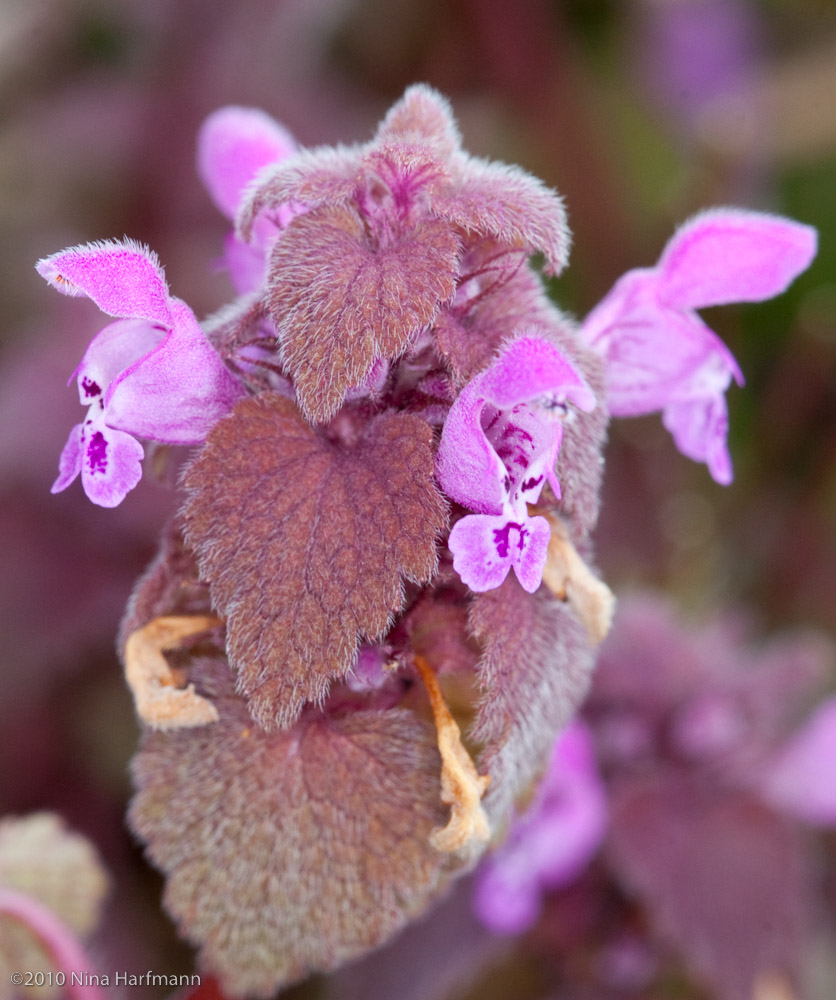
Covered by a giant purple carpet, they glow from edge to edge with the bright, pink-lipped flowers and soft, fuzzy leaves of an alien mint, Purple Dead-nettle, that quickly moves in to these resting fields, leaving only a few toe holds for the most enterprising of others.

Purple Dead-nettle, Lamium purpureum


Field Pansy, Viola rafinesquei

Step into the ankle-deep magenta sea,
wade past a few field pansies, their heads bobbing as they struggle to rise above the waves, and you’ll find its smallest residents happily riding the current, tails held high.

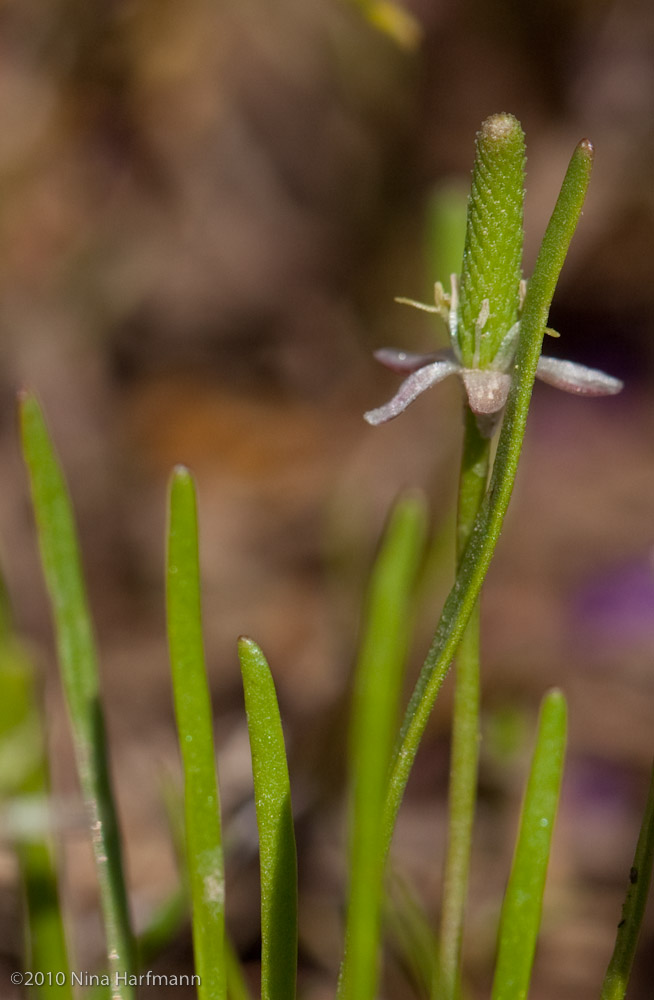
Mouse-tails, Myosurus minimus

They’re Mouse-tails, Myosurus minimus, a tiny native buttercup in this, its easternmost range. Barely more than a tuft of grass at first glance, these small plants have distinctive slender green flowers that elongate into the tail-like fruit as they mature.

Mouse-tails flowering


Mouse-tails in fruit

But you’d never know they’re lurking there--like the quiet mouse that scurries through the rooms of my old house,
and gives me just a glimpse of him when I have forgotten.

Dead Sea


Henbit, Lamium amplexicaule

Another mint eagerly fills waste places along roadsides.
It's Henbit, Lamium amplexicaule, whose leaves wrap the stem more closely and without stalks.
Again, the bright pink, 2-lipped flower is striking to look at up close!


This post continues last week's adventures with the
Midwest Native Plant Society
and Jim McCormac.

Stumble Upon Toolbar

Monday, April 4, 2011

Searching for spring

Draba verna

"He who hopes for spring with upturned eye
never sees so small a thing as Draba.
He who despairs of spring with downcast eye
steps on it, unknowing.
He who searches for spring with his knees in the mud
finds it, in abundance."

— Aldo Leopold

For much of the world, the arrival of spring is a showy occasion.
Like the young girls in brightly-colored, petticoated dresses, we expect the celebration of the season to wake us from winter with a visible alarm. While the temperatures dance back and forth across the freezing line and imperceptible changes slowly unfurl, we struggle to nail spring to the calendar, define it by the things we can see.

Crocus

Glory-of-the-Snow

We mark it boldly, watching for blooms from tulips and daffodils, as if with loud proclamation we might tether it a bit more securely.

But nature’s spring is far more subtle.
Her change is quiet--hidden beneath the tangle of faded stems on a barren field, softly peeking past layers of leaves on the treed hillside of a southern slope.
By the time we realize it’s here, a good portion of spring is already gone.

American Columbo
first leaves of spring

Last weekend I walked with Jim McCormac and the Midwest Native Plant Society in search of those earliest and seldom seen, quietly productive, first-bloomers of spring--the understated, perhaps under-appreciated little mustards. In Adams County, rich in botanical diversity because of its unique combination of geography and geology, we would find them. And, as is often the case, the least spectacular place (especially if you’re driving past at 55 mph) held the greatest botanical find.

Earthstar puffball

Stepping carefully from our vehicles, we fanned out into a small, local cemetery, stooping low, eyes combing the ground in search of our conquest, the tiny Little Whitlow-grass, Draba brachycarpa.
This neat little mustard stands barely an inch high and can easily be lost in the taller trimmed grass surrounding the grave sites. Happy to settle in to the continually disturbed sandy soil in this one of just a few known deposits along the Ohio River, dozens of these small, rare mustard plants jockey for space, while prickly pear cactus and earthstars delight in the southernmost Ohio sand.
The hardest part is finding the first one.

Draba brachycarpa,
photo courtesy Tricia West

“Is this it?”
A small plant is gently isolated, swept clean of broken stems and weathered leaves covering it, basal leaves examined, stem and flower head scrutinized.
“YES!”
And the group drops to their knees, each chin on the ground, as only a mustard can be appreciated.

Draba brachycarpa, in bloom
photo courtesy Tricia West

in fruit

Soon, the hidden treasure is spotted all around, some still in their delicate white flower, most already in fruit—stubby, purple pods (brachycarpa=short pod) that can barely be seen unless you’re nose-to-nose with the little Draba.
At first glance, it might seem we're still waiting for spring.
Look closely, stoop low.
If you're a little mustard, spring has already happened.

Draba brachycarpa, Little Whitlow-grass
in fruit

The genus Draba accounts for 365 species in the mustard family (Cruciferae or Brassicaceae) worldwide, characterized by a 4-part flower whose petals stand at right angles to each other, resembling a cross. Another important diagnostic feature of those in the mustard family is the fruit, a silique, an often long, (except when it’s short!) pod-like form, filled with seeds which easily tumble forth when dry.


Draba verna, Early Whitlow-grass is growing in large patches on my lawn.
Each of the 4 petals is deeply divided, giving the appearance of 8.

Stumble Upon Toolbar

Monday, March 28, 2011

Hawks at a Distance

It’s a crisp, clear day in late March--
the trees still bare, the farm fields wide and wanting.
As I walk the empty country lane, a speck of a bird soars high in the sky above me, beyond anything that I can clearly see, against an expanse of blue. Steady and strong on a column of air, he slowly carves a wide arc without so much as a wing beat. I name him easily and walk on—a red-tailed hawk. It just seems right.
No one will know if I am wrong.

At any other time, I wouldn’t dare to name such a bird.
Like sparrows and fall warblers, hawks at a distance confound me. I struggle to see field marks clearly and mumble about dark shadow or bad light. Even decent binoculars fail to bring the bird close enough to allow me to match it to that crisp and clear image I might later check in one of my many field guides.
So how do these better birders do it?

Jerry Liguori, a leading expert on North American raptors and hawk-watcher since the early 1980s, lets us in on a little secret in his forthcoming book, Hawks at a Distance : Identification of Migrant Raptors, to be released next month from Princeton Press. This follow-up to Hawks from Every Angle is jam-packed with all aspects of in-flight hawk identification tips, including the inspiration I need to set aside my frustration and work harder at viewing and identifying these small specks in the distant sky.
Simply said, while it’s impossible to identify every bird, shape and flight style can be used to distinguish most distant birds whose plumage isn’t easily seen.
Put those scopes away!

Liguori’s latest book applies this strategy to 29 raptors--20 commonly seen in their North American migration; and 9 less so, including the California condor, several kites and zone-tailed hawk. The full-page color portrait of each species account is accompanied by a series of smaller flight shots—usually numbering 18 to 30 (but in the case of multiple races of red-tailed hawks, 78!) that show the bird in “real-world” settings. Each of these 558 well-chosen, color images depicts a distant bird in flight as it displays a variety of postures and is seen in conditions of varying light. Whether backlit or shadowed, or if colors have been transformed by warm tones of an afternoon sun—Liguori shows raptors as they are seen in the field and highlights the few lines of text with boldface descriptions of the most critical features to look for. Traits that might only be seen at close range have purposely been left out.

His brief introduction touches upon age and color morph terminology, follows with a 1-page glossary and wraps up with a simple diagram of bird anatomy. If it’s not related to the viewing or physical characteristics of the birds, though, it’s not in here. Life histories, range maps…none of that. This field guide is strictly a collection of ID photographs and accompanying identification tips.
In that, it does very well.

Perhaps because one might wonder if Liguori's preference for this distance id approach has arisen by default from a stack of distant photographs, he's included a section on photography and the ethical questions it raises for wildlife watchers. Must we approach so closely as to intrude into the bird's world, disturb a nest site, chase or bump birds, repeatedly harass a single subject, lure a raptor with live bait... just to get a fantastic shot? To other photographers, ethics might be overlooked. But, it seems Liguori's use of distant shots is a choice he's wisely made--and his discussion of ethics and integrity one I, especially, appreciate.

An interesting final chapter entitled, “Shapes” is as it suggests--896 black and white silhouettes that wheel across the last 19 pages in soaring, head-on, flapping, gliding and wing-on positions, allowing for easy comparison of images side-by-side.
As it is with so many guides available to the birding enthusiast today, Hawks at a Distance cannot capture in a single volume all there is to understand in the world of birds, especially the world of raptors, nor does Liguori claim to do so. What he has created however, is an awesome array of birds as they are seen by those who watch them--birds in the field for birders in the field--and practical tips for their identification.
And the closing thought that regardless of correct identification or successfully captured photograph, the joy in watching them, even at a distance, is often enough.

Stumble Upon Toolbar

Saturday, March 12, 2011

This is Spring

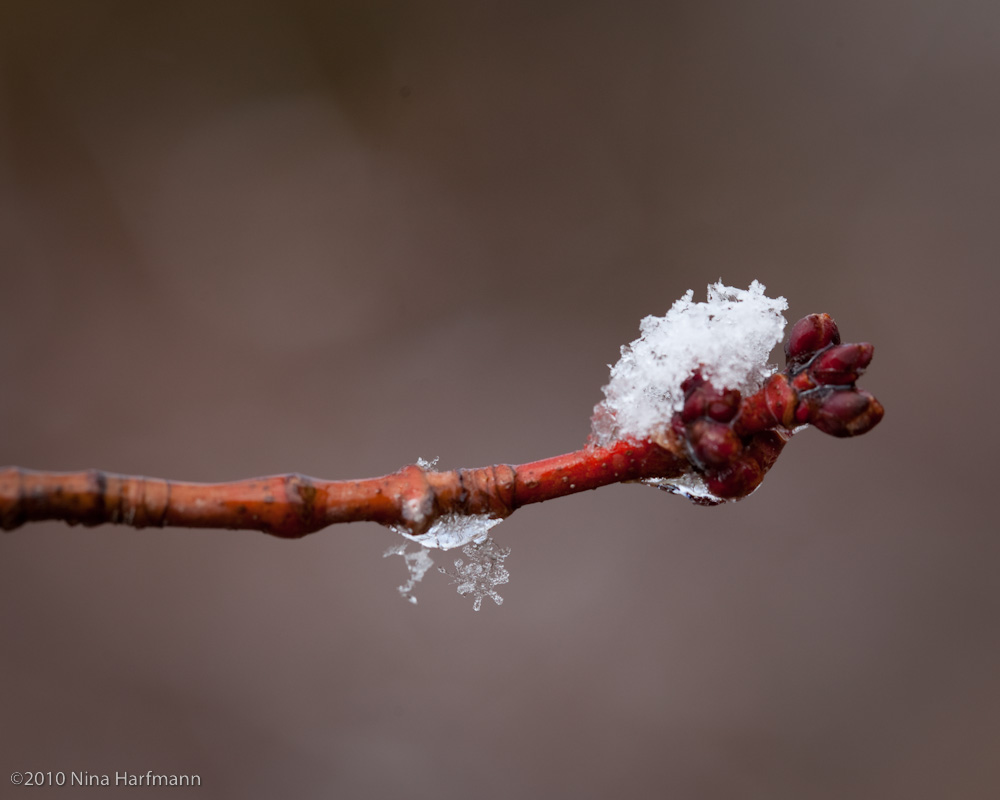
Snowflake on Red Maple

My ritual of spring has begun---with daily visits to each of my 2 vernal pools, now filled to the brim with melted snow and repeated spring rain, and nightly vigils as I wait for what I remember as clearly as if it happened just yesterday, the return of the spotted salamanders.

Vernal Pool

Lichen and Snow

But as I wait by the edge, spring steps forward and back, hesitating to make her bold entrance with a surge of warmth and bright sky. Instead, I find the ground beneath this small red maple crusted each morning with a thin but firm layer of ice. Its lichen-covered bark glows green on a clouded March morning.

Spring Snow and Spiders

Snowflakes spin on cords left by an ambitious spider who thought perhaps she’d wrap this small tree before its resident tree frog wakes and takes up its summer residence here. The water is dark and still. By noon most of winter’s remnants are gone. And the cold nights and crisp mornings of this week have filled the sap buckets that hang in the yard.

First Green

A few warm days have coaxed the first green from the earth. Tentative fingers emerge in the leaf-cluttered gardens ringing the old, brick house. Planted by a previous owner years ago, I know to expect them too. Their perfect green, soft and clean, has a tenderness barely hours old. They have brought a smile to my face--a smile that no one will see.

Another cold, clear night passes.
The day warms with sunshine until the mild air smells sweet. In the driveway, while curls of steam rise from the broad evaporating pan, gallons of maple sap steadily boil their way to become the prized amber syrup.
Beside the pool, the tangle of coarse weathered grass has become soft.
By evening, a warm rain begins to fall.

Crayfish foraging in leaves

In the dark, a brightly colored crayfish forages in the leaves caught in a crack beside the back porch floor. A steady run of rain from the roof spills onto his back as he moves slowly forward in this crevice, probing the puddles with his giant claws, sensing small bits of food with his antennae. The yard has come alive in this wet darkness.

With each step forward as I walk with my light, glistening earthworms brought to the surface to bask in the rainy night retreat hastily, disappearing to the safety of the softened ground.
And from beneath earth that lay frozen and buried beneath months of winter snow, from the woods they walk, crossing roadways, crossing lawns…stepping through my garden.

Spotted Salamander on Spring Migration

Where I first smiled a smile not seen, this time another is watching.


Spotted Salamander

The spotted salamander, Ambystoma maculatum, is one of the species of mole salamanders that lives underground for 50 weeks of the year, returning to vernal pools in the springtime for a brief 2-week period of breeding. These nocturnal and secretive amphibians are seldom seen unless encountered on their migrations to breeding pools at night.
Vernal pools seldom hold water beyond the summer months, appearing to be of little value in their empty state. Yet, to mole salamanders and wood frogs, these ephemeral wetlands are critically important.
More information about vernal pools can be found in previous posts.


Stumble Upon Toolbar