Friday, January 14, 2011

The Flaming Owl

Rural Ohio in January

It was cold.
From where I sat, impatiently idling in the deserted intersection beneath a single swaying red light, I looked across to an illuminated bank sign at the corner of Rt. 36 that confirmed it—1:42 p.m., 13 degrees.
Although I was heavily dressed in layers of fleece and tightly tucked into my warmest of woolen socks, my toes still held the chill they had gotten in my brief walk to the car, though its heater had been sending a steady blast of warm air past them for the last 2 hours.
Crossing Ohio just to the north of Dayton, driving east along the wind-buffeted route that took me past sprawling farms, their wide fields white and quiet, I would soon arrive at Big Island Wildlife Area, 35 miles to the north of Columbus. For the most part, the travel was easy. Only as the clusters of homes and small villages stretched further and further apart to become barren flatland, did drifts and icing-over become a concern.
Already, everything about this place, everything about this day made it a perfect one for winter birding.

Months before, this drive would have been a very different one. In May or June, I might have seen an oriole or a tanager flitting through the branches of a big, old tree in town, indigo buntings singing from the top of the tallest corn stalk beside the road, woodcocks displaying in the evening light above the grassy fields. Missing them and many others who have flown south to warmer climes, I forget that in their place, others have arrived for just a brief stay.
For those to our north, this is the south.
And a winter’s day can show them at their finest.

Field in Snow

The sunshine of the morning blew past. Left in its place was a dark sky that dropped swirls of snow dancing onto the shoulder of the road before spilling over and filling the ditch. I turned carefully from the highway onto a gravel county road, where several cars had passed ahead of me leaving just 2 narrow tracks to follow. Over the field beside me, a northern harrier floated low, tipping and turning, looking and listening for small prey scurrying just feet beneath him in the grass. This expanse at Big Island, a combination of wet prairie, grassland and cropland, is the perfect habitat for both the small rodents and the predators like this hawk whose diets they compose. The harrier continued his course, scouring the tall grasses for mice and meadow voles. On the opposite side of the road, a northern shrike watched for the same from a perch on the tip of a small brushy tree.

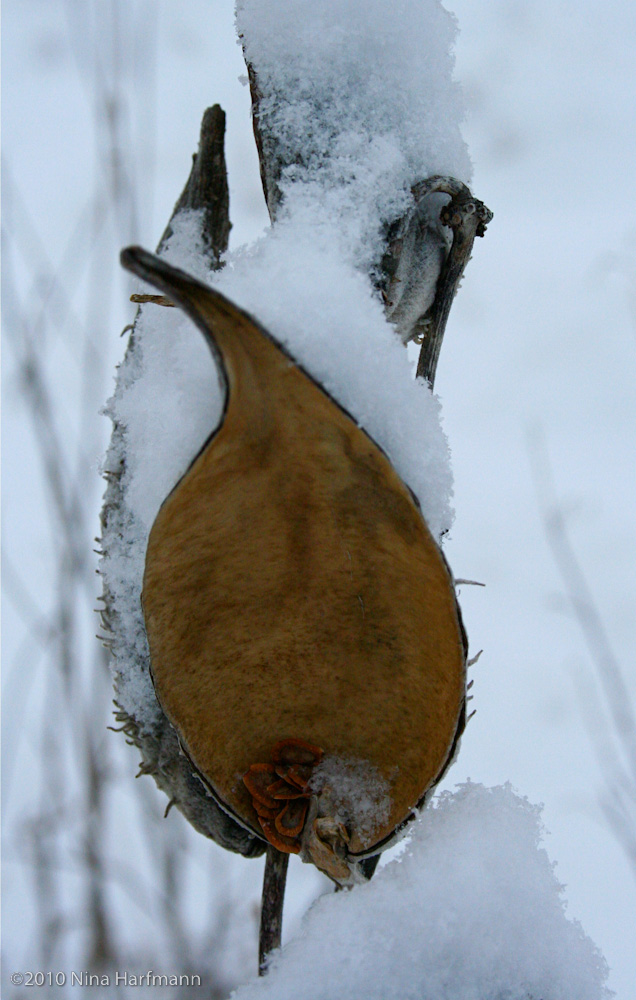
Milkweed Pod in Snow

I parked the car and walked back through the grassy field toward the tree line, staying within the shelter of one of the dikes containing a small pond. The wind had picked up its pace. Flurries filled the air until the trees ahead of me almost disappeared into the whiteout. My fingers ached within the heavy gloves and my eyes teared with the sting of the cold wind, fogging my binoculars as soon as I brought them to my face. Something was flying in the distance though, with long flappy wings that showed white from below, and a head short and dark. It was an owl.

Short-eared Owl, Asio flammeus

Short-eared owls, similar in size to barn owls, breed to the north in Canada and Alaska and winter in open grasslands to the south where milder temperatures and abundant rodent populations provide a steady food supply. Unlike other owls, Asio flammeus, Latin for flaming or the color of fire, rests on the ground, roosting in trees only when snow cover is extreme. Hidden within the tall stems of golden grasses or standing still in a field of cut corn dusted with white snow, their buffy breasts and tawny tones make them almost invisible.

Grass in Snow

In the distance, the owl had dropped down. His keen eyes and acute hearing so vital to his skill as a hunter would mean I could not approach without his first seeing me and flying off. There is no sneaking up on an owl.

Short-eared Owl at Sunset

Just beyond the grassy field, as the afternoon sun re-emerged from the snow clouds for the last moment of warmth before evening, 5 birds lifted from a cornfield and circled overhead as I sat nearby on the snow. Catching the light on their richly brown backs, broad, round faces glowing in the fleeting light of evening, they turned again and again, flying above me for the last minutes of the day, then settled hidden again into the grassy field.

The ride home seemed somewhat warmer, though in passing the bank, the sign still registered only 13 degrees.
Perhaps it was winter's cold that was slowly lifting.
Or maybe it was the afterglow of watching the flaming owl.


The short-eared owls of Big Island Wildlife Area


Stumble Upon Toolbar

Friday, January 7, 2011

Christmas Mouse

A great horned owl calls into the cold and clear predawn air.
I know that on a morning like this I will find a brittle layer of ice left atop the water bucket in the barn.
The ground is frozen firm.
We are in the dead of winter.


While the house is dark and still, I slip downstairs and through the kitchen to the laundry room, gently sliding the door aside and peeking tentatively inside. Separate from the hustle bustle of the household and warmed by the water heater within, this small, quiet space has become a sanctuary for our newest resident.


If I am lucky, as my day slowly begins, I will catch her in her last hour of wakefulness, watch her as she wraps up her nighttime routine snacking on walnuts and scurrying about inside the small plastic box on top of the dryer.
She was the first gift of Christmas—a little Christmas mouse.


At the height of holiday preparations, with just 2 days till Christmas and relatives soon to appear, I discovered while cleaning, that the smallest of house guests had already arrived. Tucked behind boxes of decorations still waiting to be spread across an empty tree and cowering in the corner of the back staircase, she was almost entirely overlooked—her small, brown form barely the size of the tip of my thumb. Defenseless and with her eyes still sealed firmly shut, she made no attempt to run from the advances of the vacuum. In fact, aside from a constant tremble, the tiny mouse scarcely moved at all.

Hoping that this inconvenience would magically disappear from my workspace as mysteriously as it had appeared moments before, I went on about the business of Christmas. After all, there were beds to be changed upstairs, groceries to be brought in from the car, presents to be wrapped and festooned with bows…and what of the dozens of cookies? There was simply no time in all this for a mouse—especially a mouse that was missing its mother.

When I returned an hour later and found her unmoved and still trembling in the spot that I had left her, the human guests now enroute from the airport, relocating her seemed the only option. But to where? White-footed Deer Mice live in the woods and fields all around our old house and often seek shelter inside as the weather turns cold each fall. To turn her out now would be uncharitable, at the very least. More likely, to one so young, a certain and frosty death.

I nudged her gently with one finger. She rolled onto her side on the hardwood floor and curled into a ball, quivering and listing with any attempt to walk. Realizing it had probably already been too long since she’d had nourishment and warmth, I scooped her up. Her tiny white feet were icy cold, and she wriggled into the warmth of my hand as I closed my fingers around her. At the very least, she needed heat. But, there would be no heroic measures. There simply was no time for a mouse.

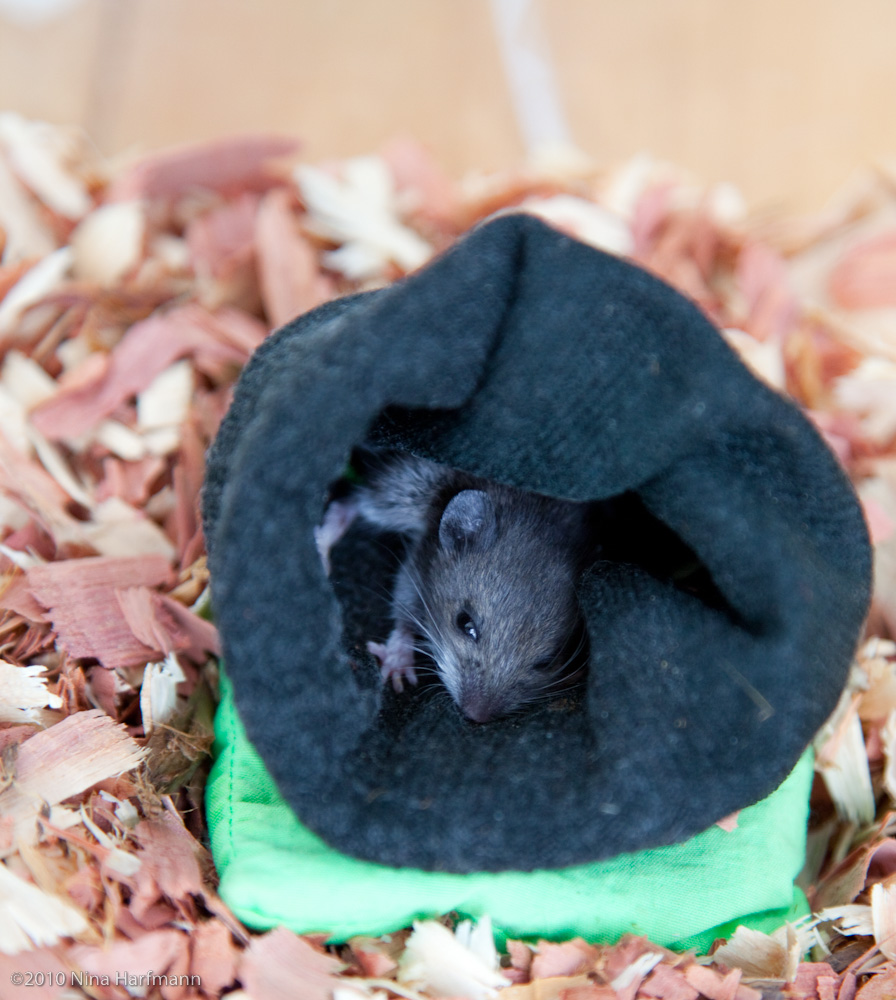
Christmas Mouse

White-footed Deer Mouse, Peromyscus leucopus

From the over-stuffed laundry basket, I retrieved a warm and wooly orphan sock--one long-awaiting its mate and unlikely to ever find it buried beneath a pile of clothes. Snipping off all but the toe and folding it back to make a cuff, I soon had the perfect cozy, dark sleeping sack, which she immediately disappeared into.

bed on beanbag for warmth

The offer of a nice fluffy wad of blue and green dryer lint pleased her immensely, and she fussed furiously at it, pushing and pulling it into a thick blanket stuffed snuggly within the sock. Only for the aroma of peanut butter and oatmeal on the tip of a toothpick did she emerge, her tiny whiskered snout sniffing and lapping at the tasty treat. With the strength to take food, she might make it through the night. I fed her as much as she would take, left her with a small wedge of apple and some ground walnuts and tucked her into the woolen bed with a warmed beanbag beneath it. Beyond the dark and quiet of the laundry room we would have our Christmas.

lining her bed with flannel lint

"Not a creature was stirring..."


Christmas morning, she devoured a juicy blackberry, and by noon 2 bright, black eyes had opened to greet my frequent visits.


The boxes filled with Christmas have been packed away.
The busy rooms are quiet once more.
The house guests have gone to their homes, except one--
a little Christmas mouse.

I am waiting for the ground to warm, for the path to the woods to soften.
For I know the perfect place where she can be just a mouse, again—
beneath an old apple tree, where the ground is littered with black walnuts, and the field is filled with blackberries.
It will feel like home.


.

Stumble Upon Toolbar

Sunday, December 12, 2010

Echo Island or A Visit to Squire's Table

Echo Island, Lake Kabetogama
Voyageurs National Park

mallard feeding at shore

Echo Island is tucked just several hundred yards off shore in the southwestern corner of Lake Kabetogama. Facing away from the resorts and private camps that line the lake edge, the island sits like a shy child caught in the midst of a party—its tree-lined shoulder turned inward, protecting on the other side a small rocky bay.
Set ablaze by the late September sun, its evergreen shore warms to gold. The small island barely visible beyond misted morning water, by evening, has found itself in the spotlight.

Echo Island, afternoon sun

Taking a direct path from the sand beach just beyond our cabin’s doorstep across this narrow band of water, skirting the gilt edge of Echo Island, we found the rocky bay, entered and pulled the canoe up onto a sequestered 20-ft beach.


Butter and Eggs, Linaria vulgaris

Once privately owned, as was the case with many islands which over the years have become part of Voyageurs National Park, remnants of its previous life remain. From within a tumbled pile of what must have been, years ago, a meticulously built rock wall entry, a mink watches our slow progression onto land, and then disappears into the depths of the woods. There is a park campsite here, complete with one-seater and bear-locker, available to anyone at any time.

American Red Squirrel, Tamiasciurus hudsonicus

On this day we find it empty, inhabited only by a most irritated red squirrel whose duties of the collection and disposal of pine cones evidently our mere presence has interrupted.
In the change of ownership, this small resident has risen in stature.

Red Pine with lichen-covered bark

Dense and damp within, the woods of Echo Island, aside from birdsong, are silent. A heavy blanket of needles from towering red and white pine carpets the ground. Soft and fertile beneath it, a bed of dark organic matter has formed on top of the sandy base.

moss and lichen

Cushions of moss run over every rock and envelope every fallen form.
Into it reach the roots of delicate wildflowers.
Lichens cover bark and branch.

Pink Corydalis, Corydalis sempervirens

Nose to the ground in this well-appointed space, I can see Pixie Cups and Fairy Thimbles, Witches’ Beard above me, and British soldiers below--
named for the shapes they resemble, to be sure.

Pixie cups

And perhaps for the enchantment left by time spent in the places where one might find them.
For I thought I caught a glimpse of something magical there.


Harebell aka Fairy Thimbles, Campanula rotundifolia


Squire's Table

Stumble Upon Toolbar

Thursday, December 2, 2010

Wandering back through my summer

I woke to a leaden sky, and a cold, damp dawn that in every way spoke of winter’s return.
I love this season more than do most--its character of change, its constant contrast from the delicate vulnerability of a single snowflake to the strength and fury of a stinging blizzard. But, given a shorter day, one bound by a hesitant sunrise and hasty sunset, I am left with little time to be in the outdoors.
It’s just as well.
This is the space between the holidays.

To that, introduce deer hunting season with its dangers to off-trail pursuits, and it's likely that a trip to the store or a jaunt along a tamer trail will, in this time, replace my walk in the woods.
I wander through my summer memories.

Lake Kabetogama
Voyageurs National Park

This is Lake Kabetogama (Ka-buh-toh'-guh-muh), an expanse of cool, clear northern Minnesota water that, linked with Rainy Lake, Sand Point Lake, and Lake Namakan, makes up Voyageurs National Park.

Un voyageur

Named for the apparently very large French Canadian voyageurs of the late 18th and early 19th centuries who paddled canoes for fur trading companies along a route between Canada's northwest and Montreal, its 55-mile length is a maze of inland waterways including over 30 lakes and 900 islands. In addition to its being a water-based park, meaning that the access to sites within its boundary is primarily by boat, Voyageurs National Park is the most recent addition to the national park system, having been acquired just 35 years ago, in 1975.

The dock
Moosehorn Resort


With walleye, northern pike, muskellunge, small mouth bass, and crappie abundant in these large lakes, fishing is by far its greatest draw. Try to find just one poster promoting the area that does not boast a boatful of broadly smiling fishermen or a toothless child proudly displaying his record-breaking catch.


common mergansers on the lake

But the attraction for me was its wilderness.
Accessible to any who wishes to hike the miles of backcountry trails or step out of canoe or kayak onto the land once walked by the Chippewa, the morning air rings with the call of the loon.
A wolf print is left in the soft mud along the trail.
And the still water is parted by a beaver swimming at dusk to his lodge at the edge of this small island.

Echo Island
Lake Kabetogama, Minnesota

Translated as Rough Waters, Lake Kabetogama at 25,000-acres in size can in one moment become a small craft’s captain’s nightmare. Wind raging its length piles 5-ft waves on top of its 80-ft depths. Islands become the only refuge in a storm.
But, each morning it lay again invitingly still—shrouded in a heavy fog that obscured both boat and bird.
And begged to be discovered.

Foggy Morning


Morning Sun


Stumble Upon Toolbar

Sunday, October 3, 2010

Making a list

Birders and lists go hand in hand.
We keep yard lists, trip lists, life lists.
If you’re anything like me, this turn of the season, an almost overnight change to the crisper days of autumn, has prompted the generation of yet another list--an attempt to stay on task and responsibly navigate the fleeting fall months to come. There’s a cluster of family birthdays for which to prepare, window screens to wash and tuck away for winter, patio furniture to clean and cover, piles of plants that wait to be set into the ground...and, yes, plans to make for the holidays—
a list of givers and gifts.

A new book for birders will hit the bookstore shelves later this month. It’s The Stokes Field Guide to the Birds of North America by Donald & Lillian Stokes. This substantial paperback resource from the well-respected heavyweights of the birding/nature world covers 854 species in 816 glossy pages. A work of photographic excellence, its 3400+ images have been contributed by nearly 200 photographers, the majority by Lillian Stokes. A bonus downloadable CD is included with the calls and songs of 150 birds common to North America.

While the debate will continue as to which type of field guide illustration serves the greatest use, I find that I refer equally to guides illustrated with paintings (Peterson or Sibley) and those with photographic images (Kaufman or Stokes). Both have a place on my bookshelf. I still prefer the detail Sibley is able to show on the wings of soaring raptors as seen from below, but find the strength of the Stokes Guide to be its comprehensive coverage, often spanning several pages to include images of adult and juvenile birds, summer and winter plumages, morphs and birds in flight. The Red-winged Blackbird is detailed in 9 photos across 2 pages with remarks of the 14 subspecies. And 23 photos covering morphs and immature birds fill the 4-page spread profiling the Red-tailed Hawk. Most helpful to me, however, is a small notation in the lower corner of each photograph encoding the geographic location and date by month represented by the bird in the image. With a little guesswork, I can convert Stokes’ identified birds to those unknown birds beyond my window. Those tricky fall warblers in their non-descript plumage? They’re in here, in such generous numbers to fill the gap often left by other guides. Could that be a Nashville Warbler outside my window? Why, yes! Here’s one that looks just like it in a photograph bearing the caption OH/10! Maybe you’re curious to see the 3rd winter plumage of a Glaucous Gull? It’s in here, too… just a little further off the beaten path, marked RUS/12. I like that!

Birds are presented in the guide in phylogenetic order and are grouped by family with user-friendly, easily-visible bands of color at the base of each page, as in the popular Peterson guide.
Because a bird’s overall shape is often more consistent than variable plumage, the Stokes stress “quantitative shape” in carefully describing the hundreds of species--an expression that compares the relative difference in length of body parts within the same bird. For example, the Little Blue Heron is described by noting, “neck is shorter than body.” In emphasizing these relationships, even subjects which may be backlit or at a distance, can be accurately identified using careful observation and understanding of shape.

Throughout the book, Identification Tips are provided within typically challenging groups of birds. These helpful highlights offer clues for birders of all skill levels—from the basics of discerning differences within groups of seemingly similar birds to hints for especially difficult Species IDs.
Because most species are presented on separate pages, I find that comparison between several species at once unfortunately often involves the flipping of pages back and forth.

Finally, as one who shies away from the term “birder,” preferring to think of myself more as a generalist, I especially appreciate this guide for the glimpse it offers beyond birds alone—we see a small snippet, a suggestion of habitat. Whether perched on a precipice or wading among the reeds, the unaltered photographs allow recognition of birds in context—a valuable impression often lacking in other sources.


The Great Giveaway
(or Let’s turn the World on to Birding!)
Three lucky people will receive a complimentary copy of
The Stokes Field Guide to the Birds of North America
by Donald & Lillian Stokes.
If you would like an opportunity to be chosen as a recipient
of one of these outstanding field guides,
please leave a comment in the comment section of this post.


Winners will be chosen on October 25, 2010 (its release date) by the True Random Number Generator at Random.org from the total number of comments generated to this post by 11:59 pm EST on October 24, 2010.
Enter as many times in as many separate comments as you like—the greater the number of comments you leave at this post, the greater your chance of being chosen!
Limit one complimentary copy per participant.

Let’s start with something like this…
“That sounds like a great gift for my neighbor!”
Be creative, be original (if you can).
Remember, this guide is appropriate for both novice and experienced birders.
Do you have someone in mind? (no names, please!)
Let’s turn the world on to birding!

Stumble Upon Toolbar

Friday, October 1, 2010

Advice from an Old Goat

Sylvie

Where are you going, as I stand here behind wise eyes that watch you as you pass?
And what is it you are looking for?
I used to be your favorite, you know, your first.
I remember the hours we spent each day together sitting in this field.
It hardly seems like fourteen years.
And all the time, you never seemed to mind the green-trimmed holes I chewed in your t-shirts, or the way I marked you as my own with rubbings against your knee.
We jumped and climbed... and frolicked beneath a blue sky, you and I.
And you brought me goldenrod.
I know…
Life.


Others younger have come and gone.
Bigger and bolder—in every way they made sure I knew my place was always to be the very last.


Once a dozen, now we are just three.
But who would have thought I would be queen?
I know…
Life.


Stop a while and sit with me.
Marvel at my soft and gentle lips, the whorl of hair on my forehead, the brushed-bare black of my knees.
Let me untie your shoes and wipe the sweat from your brow.

You will find the sun of an autumn afternoon to be of the most perfect kind.
Crickets are singing from the grasses of the field.
We can rest together beneath the wide blue sky.
And you can bring me goldenrod.


Stumble Upon Toolbar