Tuesday, June 7, 2011

We interrupt our regularly scheduled program...

I’ll get back to sharing Michigan’s wonderful adventure soon enough.
But, let’s press pause, set the cool air and fresh breezes aside for a moment, and catch up with a bit of excitement I found in my very own southern Ohio back yard.
After all, what would a sultry summer day be, without tales of long-legged hairy spiders to keep you awake long after darkness has fallen?
You know you won’t sleep soundly anyway. These still, muggy nights can be long, so go ahead…check out these giants of the invertebrate world in my very own version of...
The Spider and the Fly.


My morning walk through the field and past the pond produced just what I had hoped—an offering of food for the guest spider waiting for me at home in a small glass case since being discovered in a corner of the front porch Sunday afternoon. Yesterday’s meal had been quite fine, one large grasshopper, who was quickly snatched and devoured by the hungry arachnid.
This morning, barely a shell remained in the corner of her cage.
The rest had been sucked dry.


Black Horse Fly,
Tabanus atratus


A plump horse fly lazily waking on a stone in the sunshine was an easy mark. It turned slowly to look at me, with broad and dark compound eyes spaced just a bit apart— a female, and with the sturdy prominent mandibles able to inflict a serious bite. Males survive on nectar and lap sweet juices, while the female flies must have a meal of blood before laying their eggs. In a moment I had her wrapped in my hand, headed for home, a hungry spider waiting.


In the summer, you’ll likely find a guest of some sort staying with me.
Caterpillars, praying mantids, frogs, spiders—I learn from watching them more closely, never detain them for more than a couple of days, and turn them loose immediately if they won’t eat. A small glass tank is usually the perfect set-up to keep them safe and sound while I stick my nose in their business. Then they’re turned back to the wild in as close to the place as I found them, no harm done.

Common Fishing Spider,
Dolomedes tenebrosus


The spider was waiting as I knew she would be.
A large common fishing spider, Dolomedes tenebrosus, her dark banded legs could easily cover my palm. Over an inch in length, her body was covered in dense, short, chocolate brown hair.
Eight shiny, black button eyes stared back from within the glass case.

Fishing spiders are members of the family Pisauridae, nursery-web spiders.
Almost as large as wolf spiders (and in the case of mature females, perhaps larger) fishing spiders carry their eggs in a sac until ready to hatch, then construct for the spiderlings a small silken enclosure, in front of which they stand guard. Wolf spider females carry their already hatched young on their backs. What looks at first glance like fur is a writhing mass of legs and bodies--hundreds of tiny spiders!

Rabid Wolf Spider, Rabidosa rabida
with spiderlings on abdomen


The arrangement of the spiders’ eyes is different, as well. While both spiders have eight eyes, those of fishing spiders are divided into just 2 rows of 4 each. Wolf spiders have 3 rows of eyes—3 on the lowest level, 2 large ones in the middle and 2 small ones on top. So, if you ever need a quick and easy ID, look closely at that furry little face!

Common Fishing Spider with prey on tree bark

Named for their ability to take small fish from the water as they stand on the surface, the common fishing spider is actually a tree-dweller, most at home in wooded areas near water and a common hunter by night.

She’d wandered onto the porch from the woods and become quite a visible spider-shaped spot against the white brick of the old farm house.
As I had guessed, this very large spider was quite pleased with what I had scared up for breakfast.
The very large fly, on the other hand, was not at all pleased with the my hospitality.

Common Fishing Spider eating Black Horse Fly


One big spider, one big fly

Stumble Upon Toolbar

Thursday, June 2, 2011

Meeting the Heaths

Wetland in Northern Michigan

Time in Michigan allowed me a chance to meet more of the Heath family.
Nope, not the people...the plants.
These members of Ericaceae, whose species number over 3300 worldwide, are primarily small shrubs, often with leathery or resinous evergreen leaves. And because they dislike limey soils, they’re not likely to be found where I spend most of my time hiking, the till plain of the southwestern Ohio River Basin.
Heaths prefer the cooler temperate regions—the acidic soil of primarily oak woods or the sphagnum mats of (acidic) bogs.

Sedge Wren beside a Wetland

Some are cultivated as ornamentals. You may have rhododendrons or azaleas in your yard. Others are prized for their delectable fruit. Blueberries and cranberries, the flavorful and antioxidant-rich "superfruits," are members of the Heath family, as well.

But I fell in love with bog rosemary and leatherleaf, whose creamy white urn-shaped flowers hung in clusters at the tip or along the stem of fine, scratchy branches beside a wetland in northern Michigan.

Leatherleaf,
Chamaedaphne calyculata


Bog Rosemary,
Andromeda polifolia


Bog Rosemary in flower


Bearberry,
Arctostaphylos uva-ursi


Bearberry in flower


Bearberry in fruit (autumn)

The small, round leaves of Bearberry were dried and smoked as tobacco by Native Americans.


Labrador Tea,
Ledum groenlandicum

Labrador Tea in flower

In the James Bay and Hudson Bay areas, the leaves of Labrador Tea were dried and brewed as tea.


Lowbush Blueberry,
Vaccinium angustifolium


Blueberry in flower


Do you see a family resemblance?

Stumble Upon Toolbar

Monday, May 30, 2011

Heard Only

Lake Nettie in the Morning

I wake this morning to the sound of tree frogs.
Warm, heavy air has been spread over the Ohio River valley like a scratchy wool blanket that I would peel back and crawl out from underneath, if I could.
The weight is almost stifling—the dampness on my skin, constant.
But in the hush of dawn, those few brief moments before daylight brings the rustling of leaves and the chorus of songbirds to these woods, I recall the sounds of northern Michigan—the birds heard only, not seen.
And I remember in a dream the richness their simple song can bring to a cool and silent night.

Just beyond NettieBay Lodge, our home-base for a week of Birding & Botany in beautiful Presque Isle County, a narrow gravel lane draws a straight line north past woods that give way to water, then become woods once more. Thick and brushy, an undergrowth of alders rims the single-lane road. Peering past them, white cedars with buttressed bases can be seen standing in several inches of dark swamp water. As daylight fades, the dim woods become darker still.
The sounds from beyond the road’s edge are sharp and strong as we walk past—a veery’s strident call.
Soon, the distant song of a whip-poor-will is answered by another, much closer, who sings faster and stronger, from deep within the alder thicket. This narrow lane with its dimming light is the only opening in these very dense woods--the perfect place for the wide-gaped birds to wait and snatch some tasty moths drawn to this clearing in the brush.
High overhead, against what little faint blue remains, an almost imperceptible twitter betrays the dusk display of a woodcock. Around the sky he tumbles on whistling wings, then drops to the ground in a small, grassy clearing beside us to resume his courtship dance for the benefit of one we cannot see. We leave his persistent peent at the edge of the dark woods and wander further down the road.
The sound of frogs has grown loud and shrill. Spring peepers fill the wetland. Gray tree frogs’ calls resound all around. Here, amidst the foreign, I find the familiar—what I know so well of the warm spring nights spent beside my vernal pool. Yet, to listen for birds at this water’s edge, their calls are overpowering.
Stepping away, we wander slowly back to the car and roll softly down the lane, windows down, combing the night air, soaking in the sounds of northern Michigan. The whip-poor-wills are now perched at the road’s edge. In the moonlight, their red eyeshine eerily flashes in the headlights of our approaching car as they grab insects from their posts beside the road and cross in the beam of our light to the other side.
Lake Nettie is calm and still beyond the door of my cabin. Beneath a clouded moon, the mournful call of a pair of nesting loons spreads across the 278-acre lake. Perhaps more than any other sound, it is theirs that, to me, captures all that is wild and pure of the north woods.
A call, like the others of this night, that is rich and distinctive, revealing of its place.
A call that with it brings a cool breeze to a dream in an Ohio River valley summer night.

Lake Nettie
from NettieBay Lodge

Stumble Upon Toolbar

Monday, May 16, 2011

Taking Time

Blue-Gray Gnatcatcher

A tiny bird sings incessantly from the highest branch of the tree beyond my window—a blue-gray gnatcatcher…that seemingly miniature mockingbird, with his wispy, whistle-y song. Oh, how he teased me to watch him weeks ago, playing his tiny kazoo, as I fussed with preparations for my trip to New River—a week of nature camp for grown-ups, as I’ve come to think of it.
He’s still at it today, though I’ve taken the time as he’s warned I should.
I’ve taken the time to watch nature.


blue-gray gnatcatcher's nest

Last year, afternoons were spent there watching a wee bird as she repeatedly brought small flakes of lichen to shingle her nest just feet from the Meadow House door. By mid-week, early morning wake-ups had left me with a sleep debt, but how can one nap while such business is going on?


I watched her each day, my choice only to sleep or engage with nature.
I chose wisely, and slept wonderfully upon my return.


Pennywort gentian, Obolaria virginica

This year, I spent afternoons in search of wee wildflowers—pennywort gentians just inches tall growing in the shade of mighty trees above them. And as I stooped low to marvel at the sweet, white blooms dotting the brown, leafy bank behind the Meadow House, I found an even tinier spider stepping from flower to flower, dragging his silken cord.
From one to the next he rappelled, his entire world smaller than my palm.


Again, I think I chose wisely.
For how can one sleep while such business is going on?


tiny spider
(for scale, the flowers are only 1/2 an inch long!
)


Pennywort gentian with tiny spider

Pennywort gentian, Obolaria virginica, is a small flowering plant native to southeastern North America. The only member of the genus Obolaria, it is so named from the Greek “obolos,” meaning small coin, in reference to its thick, rounded, coin-like leaves.
Varying from shades of brownish-green to dark purple, the leaves of Pennywort gentian contain little of the chlorophyll that many plants use to produce energy from sunlight through photosynthesis. Yet, these small plants are able to thrive in the shade beneath a densely leaved canopy. How?
Pennywort gentian is a mycotroph ( Gr., myco=fungus + troph=feed or grow)—a plant which gains nutrients needed for growth from the fungi in the soil layer beneath it. The fungi, in turn, have derived their nutrients from the roots of a host —a woody, photosynthetic plant (tree) towering above. In essence, the mycorrhizal (Gr., myco=fungus + rhiz=root) fungi in the soil act as the intermediary, passing carbohydrates from the tree roots to the small pennyworts covering the hillside. The woody plants gain, as well. Soil inhabited by mycorrhizal fungi is able to hold more water and minerals needed by the trees for healthy growth.

Stumble Upon Toolbar

Saturday, May 14, 2011

What's underneath it all

May apple blossom in the Rain

A blue school bus makes the steady climb along a narrow gravel drive in West Virginia.
From behind its steamed windows on a chilly morning, a group of birders looks out into the Appalachian woods, rich and wet from yesterday’s passing rain.
Higher and higher we climb.

The Bobolink Field

We’ve just come from a field in “High Country,” where bobolinks burst like popcorn from a broad, green hillside while the brisk wind tore at warm coats snuggly wrapped around birders waiting atop a grassy field on this morning in early May.
I remember them from years past in this very same place, perhaps the very same birds--
their bubbling, bell-like song falling like a shower on every upturned face.
Happy birders, every time—delighting in the abundant birdsong that each year we hope eagerly to hear again.
And then it is time to move on, leave the bobolinks to bury themselves in the knee-high grasses. Pack ourselves, bubbling, back onto the blue bus.

The New River Birding and Nature Festival provides a week’s ration of journeys just like this one—each day escorting onlookers to widely differing habitats from a misted river’s edge to high pastures and heavily wooded hills.
For me, it’s a trip beyond words.
For in the few hours’ drive that I make from southwestern Ohio, I leave the till plains of the central lowland behind and cross to the eastern Appalachian plateaus. The land becomes sharp and rocky. The trees and plants become different, too.
Instead of limestone and dolomite beneath it all, there’s sandstone, silt and shale.
What’s beneath it all determines what grows where.
What grows there, defines who uses it.


Red Trillium, Trillium erectum

This is red trillium or purple trillium, Trillium erectum, an acid-loving trillium found in the moist woods of the eastern United States. Usually bearing a deep red or purple flower, a white or faint yellow form is less commonly found.
Both color forms can be identified by the deep purple ovary visible in its center.
Commonly known as Wake Robin or Stinking Willie, the foul-smelling flower is pollinated by carrion flies. Fruit and seed dispersal is taken care of by ants.
Plants may take up to 15 years to mature before flowering!


Red Trillium, Trillium erectum


distribution of Trillium erectum
copied from Flora of North America


Stumble Upon Toolbar

Wednesday, May 11, 2011

The Birds of Sugar Creek

photo courtesy Jim McCormac

What’s wrong with this picture?
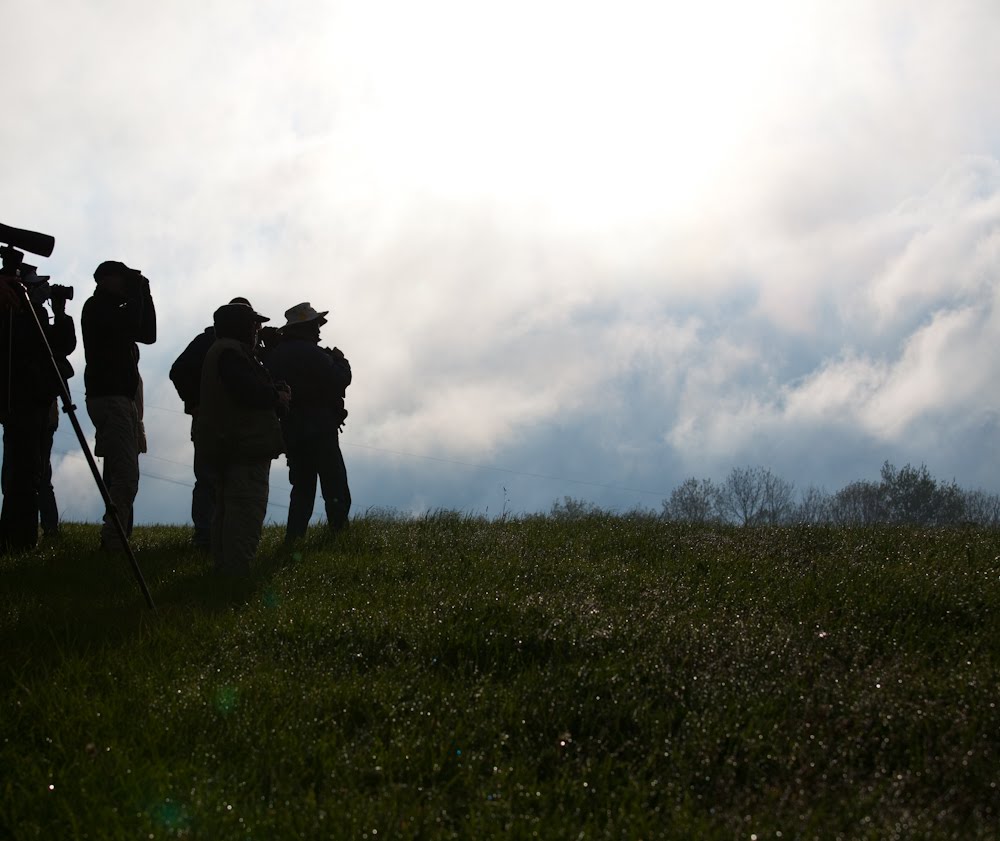
It's a group shot, from the Sugar Creek field trip at the New River Birding and Nature Festival where I spent the last wonderful week...a picture of fellow-birders, gladdened by a very birdy morning, hungrily having taken in long, lavish looks at a prized warbler as we wove a slow path down this gravelly West Virginia mountain road.
I’m that speck in the background—that stooping, bending form that seems otherwise occupied, oblivious to the purpose of the day--diddling in the ditch, while birds drip from the trees all around.
But odd as it may seem, I capture it better that way.

Scanning the bank, with each plant I create a richer picture of where I am, define a habitat a bit more thoroughly in my mind. With birdsong overhead, my snapshot is complete—a perfect picture remembered with as much detail as one might find when they recall exactly where they were or what they were doing the day that Elvis died.


Cerulean Warbler
Early meadow rue was blooming.
Little wind chimes tinkle

on a morning wet with dew.


Hooded Warbler
Through the thick woods,
brilliant birdsong hangs in the air

like tiny bells of Solomon’s seal.


Kentucky Warbler
A tangled bank is heavily planted
with bellwort, Canada waterleaf,
and a quick glimpse of a bird.


American Redstart
Jack-in-the-pulpit, tall and proud,
stands at the berm surveying the scene,
guarding the nest.

Stumble Upon Toolbar

Saturday, April 16, 2011

Little men of the spring woods

Dutchman's Breeches

I climbed the hillside and sat among pole after pole of tiny trousers, waving in the breeze of an April afternoon.


But for as long as I waited there on the leafy bank for her return, not one little laundress came to collect her things.


Where are these little half-dressed men of the spring forest?
And why do they never wash their jackets?


Dutchman's Breeches, Dicentra cucullaria

Dutchman's Breeches, Dicentra cucullaria, is member of the fumitory family, and is an early blooming wildflower native to the northeastern deciduous woods. Its finely divided fern-like leaflets make it easy to confuse with a look-alike, Squirrel Corn, Dicentra canadensis, whose heart-shaped flowers have less flared spurs. Flowers of both may be tinted yellow as they emerge and become shades of white and faint pink. Bleeding Heart, Dicentra spectabilis, a popular and showier garden bloomer, is related.

It is said that the fumitory family (Latin fumus=smoke) is so named for the smoky appearance that the bluish cast leaves may give as they emerge from the ground. Yellow corydalis, another member of this family, blooms at the same time and shows the characteristically lacy, bluish cast leaves. Pale Corydalis, with its 2-colored pink and yellow flower has a more northern distribution.


Yellow Corydalis, Corydalis flavula


Pale Corydalis, Corydalis sempervirens,
Voyageurs National Park, MN
(leaves above, flower below)

Stumble Upon Toolbar